


Marketing Analytics Manager: Job Description, Roles, Responsibilities & Career Path Guide
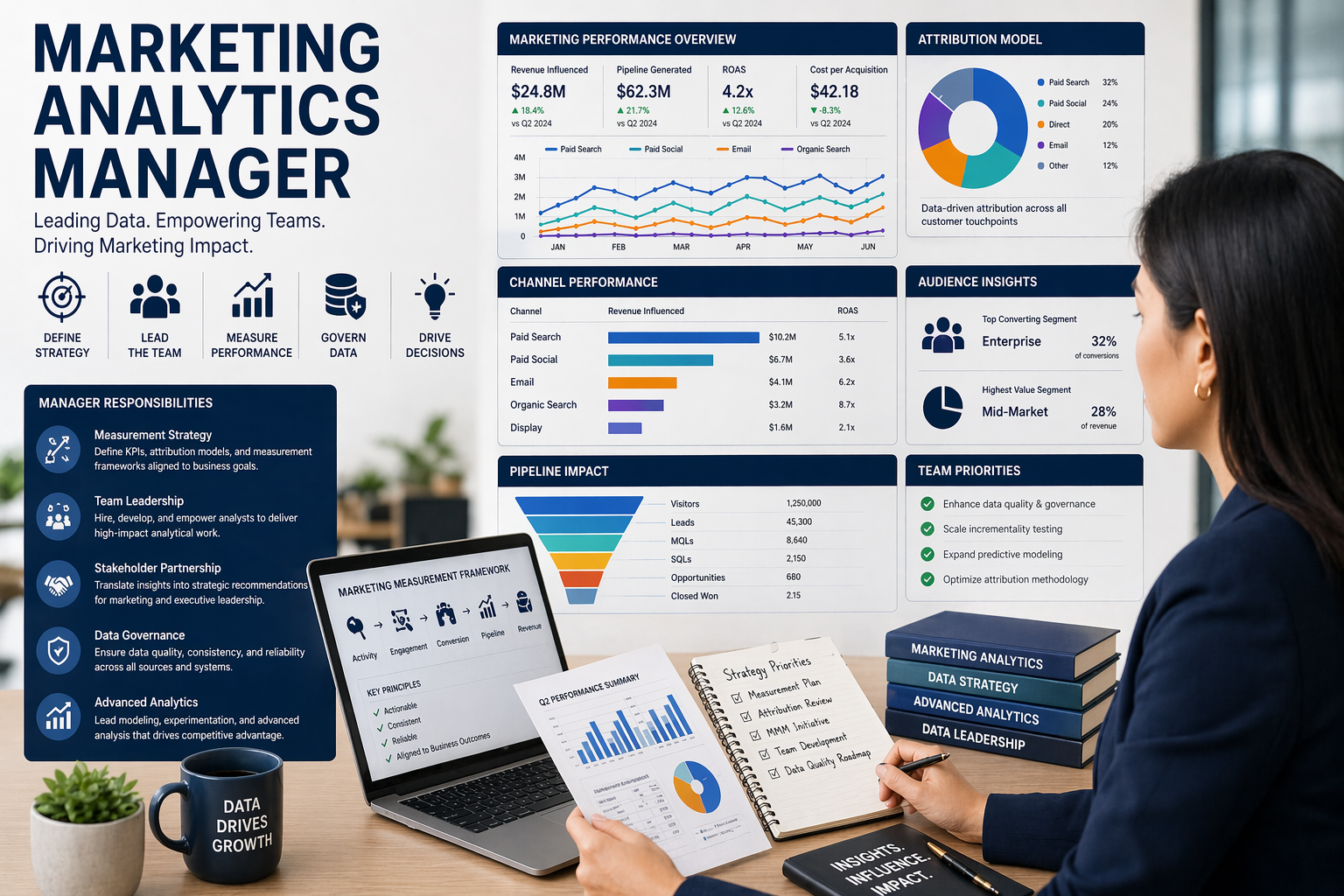
A Marketing Analytics Manager is the analytics professional responsible for leading a team of analysts, owning the measurement strategy, and translating data into the business decisions that drive marketing performance. This role sits at the boundary between individual analytical work and organizational leadership — requiring technical credibility, strategic thinking, and the ability to influence stakeholders at every level of the business.
Where a Marketing Analyst executes analysis, a Marketing Analytics Manager designs how analysis gets done. They build the frameworks, govern the data, develop the team, and ensure that the analytical function delivers business value rather than just analytical output.
This is the role where analytics careers become strategic assets — for the individual and for the organization they serve.
What a Marketing Analytics Manager Does
The Marketing Analytics Manager role is fundamentally different from every analytics role below it in one critical way: success is no longer measured by the quality of individual analysis. It is measured by the quality of the decisions the entire team enables.
The role spans four interlocking domains of responsibility that need to work in coordination for the function to deliver at its potential.
Measurement strategy and framework ownership. The manager defines how the organization measures marketing performance — which KPIs matter, how they are calculated, which attribution methodology the business uses, and how marketing connects to revenue. This is not a one-time exercise. It requires continuous revision as business priorities shift, new channels launch, and the data infrastructure evolves.
Team leadership and analytical capability development. The manager recruits, develops, and retains the analysts who execute the day-to-day measurement work. A manager who builds a strong team multiplies the function’s output. A manager who hoards work or fails to develop their team creates a bottleneck that limits both individual and organizational growth.
Stakeholder partnership and executive communication. The manager translates analytical findings into strategic recommendations for marketing leadership, finance, and the C-suite. They participate in planning cycles, defend budget decisions with evidence, and maintain the organizational trust that determines whether analytics has influence or is merely consulted.
Data infrastructure governance and quality. The manager owns the standards, processes, and systems that determine whether the analytical function is working with reliable data. Without this foundation, every analysis built on top of it produces conclusions that cannot be trusted.
Typical Responsibilities
These are the core responsibilities I see appearing consistently across Marketing Analytics Manager job postings at mid-market and enterprise organizations.
Measurement Strategy and Planning
- Designing and maintaining the organization’s marketing measurement framework — the full architecture of KPIs, definitions, attribution models, and reporting standards that govern how performance is assessed
- Leading the development and annual revision of the marketing measurement plan in alignment with business objectives and budget cycles
- Establishing attribution methodology and maintaining organizational alignment around how credit for conversions and revenue is distributed across marketing touchpoints
- Evaluating and selecting analytics tools, platforms, and data vendors that extend the team’s analytical capability
- Defining the data governance standards that ensure consistency, accuracy, and reliability across all marketing data sources
Team Management and Development
- Managing a team of marketing analysts, digital analysts, and in some organizations, data engineers — typically a team of two to eight direct reports at this level
- Setting clear performance expectations, providing structured feedback, and conducting formal performance reviews for direct reports
- Identifying individual development needs and creating growth plans that prepare analysts for the next level of responsibility
- Building hiring pipelines and leading recruitment for analyst and specialist roles within the function
- Establishing team operating rhythms — sprint cycles, prioritization processes, and request intake systems — that balance strategic project work with ongoing stakeholder reporting demands
Reporting and Performance Analysis
- Overseeing the production of executive-level marketing performance dashboards and regular reporting cadences
- Presenting marketing performance insights to senior leadership — CMO, VP of Marketing, CFO — in reviews that connect marketing activity to commercial outcomes
- Producing channel mix analysis, media efficiency reporting, and audience performance breakdowns that inform quarterly and annual budget decisions
- Leading post-campaign analysis processes that generate organization-level learning, not just campaign-level retrospectives
- Owning the marketing contribution to pipeline and revenue reporting in collaboration with sales operations and finance
Stakeholder Communication and Influence
- Partnering with demand generation, growth, content, and product marketing teams to define measurement approaches for new programs before they launch
- Advising campaign teams on targeting strategy, audience selection, and success metrics at the brief stage rather than only reporting on outcomes after campaigns close
- Collaborating with sales operations and revenue operations teams to align marketing and sales data definitions, pipeline reporting, and lead quality measurement
- Representing the analytics function in quarterly business reviews, marketing planning sessions, and budget allocation discussions
- Managing expectations around analytical project timelines, data availability, and measurement limitations with business stakeholders
Advanced Analysis and Methodology
- Leading the development of advanced measurement approaches including incrementality testing, Marketing Mix Modeling, and customer lifetime value analysis
- Overseeing the design and statistical interpretation of A/B tests and marketing experiments conducted by the team
- Building or commissioning predictive models — propensity scoring, lead scoring, churn prediction — that feed directly into campaign targeting and sales prioritization
- Identifying opportunities to apply new analytical methods that materially improve the organization’s marketing decision-making
Requirements
These are the hard requirements that appear in the majority of Marketing Analytics Manager job postings. The bar for this role is meaningfully higher than for individual contributor analyst roles — both technically and organizationally.
Education
- Bachelor’s degree in marketing, statistics, economics, mathematics, computer science, or a related quantitative field
- An MBA or master’s degree in marketing analytics, data science, or business analytics provides a meaningful advantage, particularly at larger organizations and in competitive hiring markets
- Five or more years of experience in marketing analytics or a related data-driven marketing role, with at least two years of demonstrated team leadership responsibility
Technical Skills
- Advanced SQL — the ability to write complex multi-table queries, window functions, CTEs, and performance-optimized queries against large datasets. At manager level, SQL proficiency is assumed, not aspirational
- Data visualization and BI platforms — expert-level proficiency in Tableau, Power BI, or Looker, including the ability to design a measurement architecture in a BI tool, not just build individual reports
- Attribution modeling — working knowledge of last-touch, multi-touch, data-driven, and time-decay models, including an honest understanding of what each model measures and where each one fails
- Statistical fundamentals — hypothesis testing, confidence intervals, regression analysis, and experimental design at a level sufficient to validate the statistical work the team produces and identify methodological errors
- CRM and marketing automation platforms — Salesforce, HubSpot, or Marketo at a level sufficient to design the data flows that connect marketing activity to revenue outcomes
- Marketing technology stack fluency — a working understanding of how CDPs, data warehouses, tag management systems, and major advertising platforms connect as a system, not just as individual tools
Leadership and Management Skills
- Demonstrated experience managing and developing a team of analysts — not just coordinating work, but actively developing individual capability and building team culture
- The ability to prioritize competing demands from multiple stakeholders and communicate those prioritization decisions clearly and without conflict
- Experience hiring analytical talent — defining role requirements, evaluating candidates, and making compensation decisions
- Comfort with the organizational dynamics of a function that depends on influence rather than authority — the analytics manager rarely has direct control over the decisions their team’s work is meant to inform
Communication Skills
- Executive communication — the ability to present complex analytical findings to a CMO or CFO in three minutes without losing accuracy or relevance
- The ability to write a measurement strategy document, an analytical recommendation, or a methodology explanation that non-technical stakeholders can read, understand, and act on
- Stakeholder management — the ability to say no to a poorly scoped analytical request constructively, and to redirect stakeholders toward the question behind the question they asked
Nice to Have
These skills appear in a meaningful minority of job postings and consistently differentiate strong candidates from competitive ones — particularly at senior manager and director-level postings.
Technical Nice to Haves
- Python or R — the ability to build analytical models, automate reporting pipelines, and work with statistical packages beyond what SQL and BI tools support. At manager level, Python proficiency signals a practitioner who can evaluate and guide the technical work of more junior data scientists on the team
- Marketing Mix Modeling — experience commissioning, interpreting, or building MMM analyses. This skill appears specifically in job postings at organizations with significant media budgets where budget allocation decisions depend on modeled channel contribution
- dbt or data pipeline tools — understanding of how transformation layers in a data warehouse work, what dbt does, and how analytical models get built and maintained. Managers who understand this layer design better measurement frameworks and diagnose data quality issues faster
- Experimentation platform experience — hands-on experience designing and analyzing randomized controlled trials, holdout tests, or geo-based incrementality experiments rather than only interpreting A/B test results
- AI and machine learning literacy — understanding of where machine learning methods apply to marketing analytics problems, how to evaluate model outputs, and how to brief a data scientist on a business problem rather than a technical specification
Analytical Nice to Haves
- Customer lifetime value modeling — building and maintaining LTV models that connect acquisition channel to long-term revenue contribution, enabling CAC targets that account for downstream value rather than only first-purchase economics
- Market Mix Modeling interpretation — the ability to read, challenge, and communicate MMM outputs to senior leadership, even if the model itself is built by an external vendor or data science team
- Competitive intelligence methodology — structured approaches to tracking competitor marketing activity, share of voice, and market positioning using available data sources
Leadership Nice to Haves
- Cross-functional project leadership — experience leading analytical projects that require coordination across marketing, sales, finance, and technology teams, where the manager has accountability for outcomes but no direct authority over the contributors
- Vendor management experience — managing relationships with analytics tool vendors, data providers, and external modeling or research agencies
- Budget management — experience owning an analytics tool or research budget, including vendor evaluation, contract negotiation, and ROI justification to senior stakeholders
Salary Range
The Marketing Analytics Manager role commands one of the strongest salary ranges in the marketing function, reflecting both the scarcity of practitioners who combine strong technical skills with genuine leadership capability and the direct commercial impact of the role.
The following figures reflect current US market data from Glassdoor, Salary.com, Indeed, ZipRecruiter, and Robert Half as of 2025–2026.
| Experience Level | Salary Range (US) |
|---|---|
| New to management (0–2 years managing) | $95,000 – $120,000 |
| Established manager (2–5 years managing) | $115,000 – $150,000 |
| Senior manager (5+ years, larger teams) | $140,000 – $185,000 |
| Principal / Head of Analytics | $165,000 – $220,000+ |
Glassdoor reports an average total compensation of $139,457 for this role as of April 2026, with the typical range spanning $111,400 at the 25th percentile to $176,741 at the 75th percentile. Robert Half’s 2026 Salary Guide places the starting midpoint at $117,750, with significant upward variation for candidates with advanced analytics and AI expertise.
Factors that push salary significantly higher:
- Large team management experience — managing five or more analysts signals organizational maturity and justifies senior compensation bands
- Marketing Mix Modeling or incrementality testing experience — these skills are genuinely scarce at the manager level and command a meaningful premium
- B2B SaaS, financial services, or technology sector roles in major metro markets consistently outpay equivalent positions in other industries
- Remote roles at large technology companies that pay San Francisco or New York compensation levels regardless of location
- Demonstrated revenue attribution capability — managers who can directly connect their team’s work to pipeline and revenue outcomes have stronger negotiating leverage than those who can only demonstrate analytical output
Factors that pull salary lower:
- Small-company or startup environments where the analytics function is nascent and the role involves significant hands-on execution alongside management
- Non-profit and public sector organizations with compressed compensation bands
- Roles with limited team management scope where the “manager” title reflects seniority rather than genuine people leadership
Outside the US, equivalent roles in Western Europe typically range from £60,000–£95,000 in the UK, €65,000–£105,000 in major Western European markets, with significant variation based on city, sector, and organization size.
Career Path
The Marketing Analytics Manager role is the pivotal transition point in the analytics career ladder — the moment where practitioners move from delivering analytical work to leading analytical functions. Understanding the paths in and out of this role helps practitioners plan their trajectory with greater intentionality.
Paths Into This Role
Most Marketing Analytics Managers arrive from one of three backgrounds:
The analyst track — the most common path, where a practitioner spends three to six years as a Marketing Analyst or Senior Marketing Analyst, develops strong technical and communication skills, and earns team leadership responsibility through demonstrated performance.
The specialist track — practitioners who developed deep expertise in campaign analytics, attribution, or CRO and built cross-functional influence that positioned them for broader leadership.
The consulting or agency track — practitioners who managed client-facing analytical programs at an agency or consultancy, where they developed the stakeholder management and cross-functional coordination skills that in-house management roles require.
Paths Forward From This Role
Marketing Analytics Manager  ← You are here
              ↓
Director of Marketing Analytics (Role 8) — typically 3–6 years at manager level
              ↓
VP of Marketing Analytics (Role 8) — with budget ownership and executive presence
              ↓
Chief Data Officer (Role 9) — with cross-functional data strategy scope
A meaningful share of Marketing Analytics Managers move laterally rather than vertically — into roles like VP of Marketing Operations, Head of Revenue Operations, or Director of Business Intelligence. These lateral moves often reflect the manager’s desire to broaden their organizational influence beyond marketing into the full commercial data function.
The Management Transition — Where Most People Struggle
The transition from Marketing Analyst to Marketing Analytics Manager is the hardest career transition in the analytics profession. Not because the technical requirements are more demanding — though they are — but because the nature of success changes in ways that experienced individual contributors frequently underestimate.
As an analyst, I add value by doing excellent analytical work myself. As a manager, I add value by enabling my team to do excellent analytical work — often on problems I would have solved differently, or not have chosen to prioritize at all.
The three adjustments that determine whether the transition succeeds:
Letting go of direct execution. The most capable individual contributors struggle most here. The instinct to fix the analysis rather than coach the analyst, to answer the stakeholder question directly rather than preparing the team member to answer it, is strong and counterproductive. Managers who cannot make this shift create bottlenecks rather than teams.
Learning to measure success through influence, not output. At analyst level, the quality of the work is visible and attributable. At manager level, the best outcome is a decision that was made better because of the team’s work — and that outcome is rarely attributed directly to the analytics function. Managers who need direct credit for analytical outcomes find the role chronically frustrating.
Building organizational trust as a function, not an individual. Individual analysts build trust through their own work. Analytics managers build trust through the consistency and reliability of the entire team’s output over time. A single incorrect data point in a board presentation erodes the function’s credibility in ways that take months to rebuild. The manager’s primary responsibility is ensuring that does not happen.
Common Misconceptions About This Role
“This role is a natural next step for any strong analyst.” Technical excellence is a necessary but not sufficient condition for success at manager level. The organizational and interpersonal demands of the role are qualitatively different from analytical work, and many technically excellent analysts discover they prefer individual contributor depth over management breadth. Both preferences are valid — the mistake is assuming the transition is automatic.
“The hardest part of this job is the technical complexity.” In my experience, the hardest part is stakeholder influence — specifically, the sustained effort required to maintain trust with marketing, sales, finance, and executive stakeholders simultaneously, each of whom has different expectations of what analytics should produce and different standards for what counts as a useful insight.
“You stop doing analytical work when you become a manager.” At smaller organizations especially, Marketing Analytics Managers remain active analytical contributors — building models, writing SQL, and producing executive-level analysis themselves — while also carrying team leadership responsibilities. The proportion of direct execution versus management typically shifts as the team grows and the organization matures, but the expectation of personal analytical credibility never disappears entirely.
Marketing Analytics Manager Job Market and Demand
The demand for Marketing Analytics Managers is not just growing — it is growing faster than the broader marketing job market by a significant margin. The U.S. Bureau of Labor Statistics projects employment for market research analysts and marketing specialists — the closest BLS category to this role — will grow considerably faster than average across the decade. At the managerial level, that growth is even more pronounced. Robert Half’s 2026 Salary Guide identifies Marketing Analytics Manager as one of the most sought-after roles in the marketing and creative field, citing the starting midpoint salary at $117,750 as organizations accelerate their investment in data visualization, AI-assisted analysis, and marketing automation measurement. LinkedIn’s Jobs on the Rise analysis consistently surfaces analytics-adjacent roles near the top of its fastest-growing job classifications, reflecting real hiring behavior across millions of job changes tracked on the platform — not just job posting counts. The underlying driver is straightforward: as McKinsey’s research on marketing analytics maturity makes clear, organizations that use marketing data effectively significantly outperform those that do not, and the manager-level role that sits between frontline analysis and executive decision-making is where that capability gap is most acutely felt
Where exactly to paste it: After your salary range table and before your career path progression section. It grounds the salary data in market context and gives readers the “why now” signal that makes the role feel urgent rather than just informational.
One thing to note: the LinkedIn Jobs on the Rise URL I used points to their 2025 report — double-check that URL resolves correctly on your end, as LinkedIn sometimes gates or moves these reports. If it redirects weirdly, the LinkedIn Economic Graph blog is the reliable home for their labor market data and makes an equally credible reference.
Related Roles in This Series
- Marketing Analyst — the most common path into this role
- Director / VP of Marketing Analytics — the natural progression forward
- Marketing Data Scientist — a specialist track that intersects with this role at senior levels
Related Articles
- What Is Marketing Analytics? A Complete Guide for Practitioners
- What Is Campaign Analytics? A Complete Guide for Practitioners
- Web Analytics Tools: A Complete Comparison Guide
Title Page Separator Site title
Explore the Marketing Analytics Manager role in full — responsibilities, required and nice-to-have skills, salary ranges from $95K to $220K+, and the career paths that lead from senior analyst to analytics director.
Title Page Separator Site title
Explore the Marketing Analytics Manager role in full — responsibilities, required and nice-to-have skills, salary ranges from $95K to $220K+, and the career paths that lead from senior analyst to analytics director.