


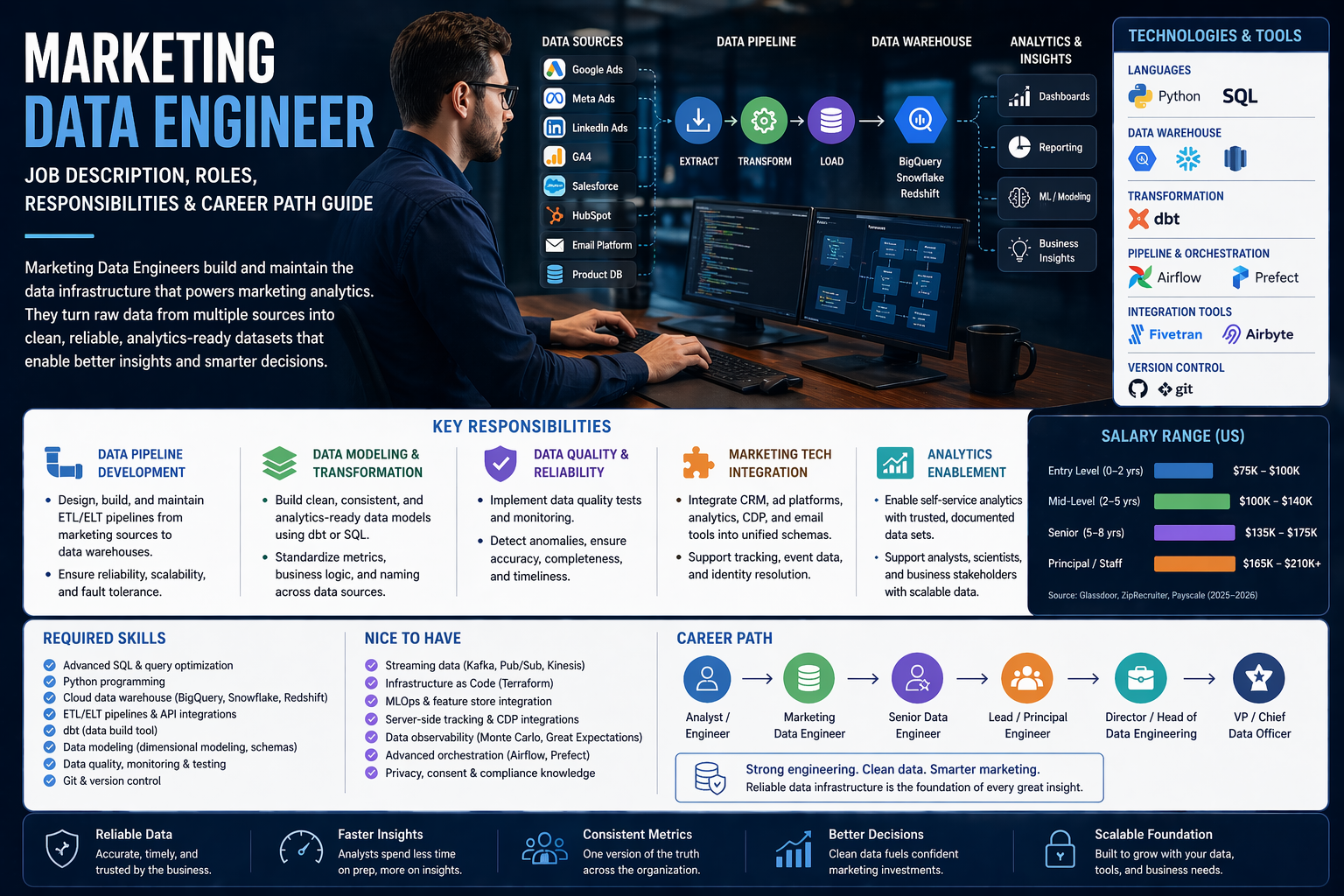
Marketing Data Engineer: Job Description, Roles, Responsibilities & Career Path Guide
A Marketing Data Engineer is a technical specialist who designs, builds, and maintains the data infrastructure that marketing analytics teams depend on to do their work. The role focuses on creating reliable pipelines that move marketing data from its sources — advertising platforms, CRM systems, web analytics tools, email platforms, and product databases — into centralized environments where analysts, data scientists, and business stakeholders can access and use it.
Where a Marketing Analyst interprets marketing data and a Marketing Data Scientist builds predictive models on top of it, the Marketing Data Engineer builds and maintains the infrastructure that makes both possible. Without clean, reliable, well-structured data flowing into the right places at the right time, every analytical function downstream — from basic web analytics reporting to advanced attribution modeling — is built on an unreliable foundation.
This is one of the most underrepresented roles in marketing analytics career content, and one of the least well understood. Most marketing analytics content focuses on the analytical and strategic layers. The engineering layer that makes those layers possible rarely gets the attention it deserves. That gap is exactly why this role is worth understanding clearly.
What Does a Marketing Data Engineer Do?
A Marketing Data Engineer builds the plumbing that carries marketing data from where it is generated to where it needs to go. The job is less visible than analysis or modeling — nobody shows a pipeline diagram in a board presentation — but the quality of that plumbing determines the quality of every analytical output that depends on it.
In practical terms, the Marketing Data Engineer spends their time on three types of problems:
Data movement. Getting data from source systems — Google Ads, LinkedIn, Salesforce, GA4, HubSpot, product databases — into a centralized data warehouse where it can be joined, queried, and analyzed. This involves building and maintaining ETL (Extract, Transform, Load) or ELT pipelines that run reliably, handle API changes gracefully, and scale as data volumes grow.
Data transformation. Taking raw, inconsistent data from multiple sources and transforming it into clean, standardized, analytics-ready datasets. This means resolving naming inconsistencies, handling missing values, enforcing data type standards, building business logic into transformation layers, and creating the data models that analysts and data scientists actually query.
Data quality and reliability. Ensuring that the data flowing through the system is accurate, complete, and timely — and building the monitoring, alerting, and testing infrastructure that catches problems before they affect downstream analytical outputs or business decisions.
Marketing Data Engineer Responsibilities
Marketing Data Engineers carry responsibility across five core areas, each requiring a combination of software engineering discipline and marketing domain awareness.
Data Pipeline Development and Maintenance
- Designing and building ETL and ELT pipelines that extract marketing data from source systems — advertising platforms, CRM tools, web analytics platforms, email marketing systems, and product databases — and load it into centralized data warehouses
- Integrating data from major marketing platforms including Google Ads, LinkedIn Campaign Manager, Meta Ads Manager, Salesforce, HubSpot, Marketo, and Google Analytics 4 into unified data environments
- Maintaining existing pipelines against API changes, rate limit updates, schema modifications, and platform deprecations — a constant maintenance burden in marketing technology environments where platforms change frequently
- Building orchestration workflows using tools like Apache Airflow, dbt Cloud, or Prefect that schedule, monitor, and manage pipeline execution across complex dependency chains
- Designing pipelines for reliability and fault tolerance — handling partial failures, retries, and backfill scenarios without producing duplicate or missing data records
Data Modeling and Transformation
- Building data transformation layers using dbt (data build tool) or equivalent frameworks that convert raw source data into clean, consistent, analytics-ready models
- Designing data models — fact tables, dimension tables, aggregate tables, and business entity models — that reflect marketing concepts such as campaigns, audiences, conversions, attribution touchpoints, and customer journeys
- Standardizing naming conventions, metric definitions, and business logic across data sources so that analysts working with different source systems use consistent definitions. This is the engineering layer that prevents the conflicting numbers problem that analytics teams encounter when different teams report the same metric differently
- Creating semantic layers that translate technical data structures into business-friendly terminology that Marketing Analysts and business stakeholders can query and interpret without data engineering support
- Documenting data models, transformation logic, and lineage so that the analytical function can understand and audit how any given metric is calculated
Data Quality Engineering
- Implementing automated data quality tests that validate row counts, null rates, referential integrity, value distributions, and business logic constraints across all data pipelines
- Building data monitoring and alerting systems that detect anomalies — unexpected spikes, drops, or gaps in data — and notify the analytics team before those anomalies propagate into dashboards and reports that business stakeholders rely on
- Performing root cause analysis when data quality issues occur — tracing problems back through the pipeline to identify whether the issue originated in a source system, an API integration, a transformation layer, or downstream consumption logic
- Establishing data SLAs (Service Level Agreements) that define acceptable freshness, completeness, and accuracy standards for each marketing data asset, and building the monitoring infrastructure to enforce them
Marketing Technology Integration
- Evaluating and implementing third-party data connectors and integration tools — Fivetran, Airbyte, Stitch, or custom API integrations — that connect marketing platforms to the data warehouse
- Integrating Customer Data Platform (CDP) outputs with analytical data environments so that audience segment definitions, identity resolution, and behavioral events are available for campaign analytics and modeling
- Supporting the implementation and maintenance of web tracking infrastructure — working alongside web analytics and digital analyst teams to ensure that event data from tag management systems flows correctly into the data warehouse
- Connecting marketing data with sales, finance, and product data to enable the cross-functional analytics that demonstrate marketing’s contribution to revenue — the foundational requirement for marketing analytics maturity
Analytics Enablement and Infrastructure
- Maintaining and optimizing the cloud data warehouse — BigQuery, Snowflake, or Redshift — that serves as the central repository for marketing data, including query optimization, cost management, and access control configuration
- Building and maintaining the data infrastructure that supports machine learning model training, scoring pipeline execution, and model output storage for the Marketing Data Scientist function
- Collaborating with the Marketing Analytics Manager to prioritize data infrastructure investments that unblock the highest-impact analytical work
- Creating self-service data access tools and documentation that reduce the dependency of the analytical team on engineering support for routine data access needs
Who Does a Marketing Data Engineer Work With?
The Marketing Data Engineer is a technical enabler — their output supports every other role in the marketing analytics function. They work most closely with:
- Marketing Analytics Managers and Directors who define the measurement strategy and data requirements the engineering function needs to deliver
- Marketing Analysts who consume the data models and pipelines the engineer builds, and who surface data quality issues that require engineering investigation
- Marketing Data Scientists who depend on clean, well-structured, high-volume datasets to train and validate predictive models
- Campaign Analytics Specialists who need reliable, timely campaign performance data integrated from multiple advertising platforms
- IT and data platform teams who own the broader data infrastructure the marketing engineering function builds on top of
- Marketing operations and MarTech teams who manage the source systems — CRMs, MAPs, CDPs — that the engineer integrates into the analytical environment
Why the Marketing Data Engineer Role Matters
Marketing analytics capabilities are only as strong as the data infrastructure underneath them. Organizations frequently underinvest in data engineering relative to their investment in analytical talent and tools, creating a situation where well-qualified analysts spend the majority of their time on data preparation — cleaning, joining, and validating data manually — rather than generating insights.
A well-functioning marketing data engineering function changes this equation fundamentally:
- Analysts focus on analysis. When data pipelines run reliably and data models are well-structured, analysts spend their time interpreting data rather than wrangling it. The productivity difference is significant — research consistently shows that data professionals spend 60–80% of their time on data preparation in organizations without mature data engineering support
- Consistent metric definitions across the organization. When business logic is encoded in the transformation layer rather than in individual analyst queries, everyone in the organization is working from the same numbers. This eliminates the “whose data is right?” conversations that consume significant organizational energy in analytically immature environments
- Faster time to insight. New analytical questions that previously required days of manual data extraction and preparation can be answered in hours when the underlying data infrastructure is well-designed and maintained
- More reliable executive reporting. Dashboard numbers that update reliably and accurately on a defined schedule, with quality checks that catch anomalies before they reach executive views, generate organizational trust in the analytics function that is difficult to build any other way
Marketing Data Engineer Requirements
The Marketing Data Engineer role requires a different technical skill set from other marketing analytics roles. The emphasis is on software engineering fundamentals, data infrastructure tools, and the discipline of building systems that run reliably without constant manual intervention.
Education
- Bachelor’s degree in computer science, software engineering, information systems, mathematics, or a related technical field
- Equivalent practical experience demonstrated through a portfolio of data engineering projects — pipelines built, data models designed, and production systems maintained — is accepted at many organizations
- Professional certifications including Google Professional Data Engineer, AWS Certified Data Analytics, Snowflake SnowPro Core, or dbt Certification carry meaningful weight given their direct relevance to the tools and platforms used in this role
Technical Skills
The following technical skills are hard requirements in the majority of Marketing Data Engineer job postings:
- Advanced SQL — complex query writing, query optimization, window functions, and performance tuning against large datasets in cloud data warehouses. SQL proficiency at this level is deeper than the analytical SQL expected of Marketing Analysts — it includes an understanding of how queries execute and how to optimize them for cost and speed
- Python — the ability to build data pipeline scripts, API integrations, data transformation logic, and automation tooling. Python is the primary programming language for data engineering work and non-negotiable at this level
- Cloud data warehouse platforms — hands-on experience with BigQuery, Snowflake, or Amazon Redshift at an administrative and development level, including understanding of data organization, access control, performance optimization, and cost management
- ETL/ELT tools and data integration platforms — experience with at least one major data integration approach: Fivetran or Airbyte for managed connectors, Apache Airflow or Prefect for orchestration, or custom API integration development for platforms not covered by standard connectors
- dbt (data build tool) — proficiency in building, testing, and documenting data transformation models using dbt is increasingly a hard requirement rather than a nice-to-have in modern marketing data engineering roles
- Version control — Git proficiency for managing data pipeline code, data model definitions, and transformation logic in collaborative development environments
Domain Knowledge
Beyond technical tools, Marketing Data Engineers need:
- Marketing platform familiarity — a working understanding of how major marketing platforms — Google Ads, LinkedIn, Meta, Salesforce, HubSpot, GA4 — structure their data, what metrics they report, and where their APIs are reliable versus unreliable. Engineers who build marketing data pipelines without understanding the domain produce integrations that miss important nuance
- Marketing measurement concepts — understanding of UTM parameters, attribution logic, session modeling, conversion event schemas, and the data structures that underpin campaign analytics and marketing measurement
- Data modeling principles — dimensional modeling concepts, star schema design, and the ability to translate business measurement requirements into technical data model specifications
Nice to Have
These skills appear in senior marketing data engineering roles and consistently differentiate candidates at lead and principal levels.
Advanced Technical Skills
- Streaming data processing — experience with Apache Kafka, Google Pub/Sub, or AWS Kinesis for real-time or near-real-time marketing data pipeline scenarios where batch processing latency is unacceptable
- Spark or distributed computing — familiarity with Apache Spark for large-scale data transformation workloads that exceed single-node processing capacity
- Infrastructure as Code — experience with Terraform, Pulumi, or CloudFormation for managing data infrastructure configuration as code rather than through manual cloud console operations
- MLOps integration — understanding of how to build the data infrastructure that supports machine learning model training pipelines, feature stores, and model output storage for Marketing Data Science functions
- Data observability platforms — experience with Monte Carlo, Great Expectations, or similar data quality monitoring tools that provide automated anomaly detection across complex data environments
Marketing Technology Nice to Haves
- CDP integration experience — hands-on experience integrating Customer Data Platforms such as Segment, Tealium, or mParticle into analytical data environments, including identity resolution schemas and behavioral event modeling
- Privacy and consent management — understanding of how GDPR, CCPA, and consent management platforms affect data collection, storage, and processing in marketing analytics contexts, and the engineering patterns that ensure compliance at the data layer
- Server-side tracking implementation — experience building server-side event tracking systems that send behavioral data directly from application servers to data warehouses, bypassing client-side tracking limitations and improving data reliability
Marketing Data Engineer Salary Range
The Marketing Data Engineer role commands strong compensation reflecting both the technical complexity of the role and the growing organizational awareness of data infrastructure as a strategic asset. The following figures reflect US market data from Glassdoor, ZipRecruiter, and industry benchmarks as of 2025–2026.
| Experience Level | Salary Range (US) |
|---|---|
| Entry level (0–2 years) | $75,000 – $100,000 |
| Mid-level (2–5 years) | $100,000 – $140,000 |
| Senior (5–8 years) | $135,000 – $175,000 |
| Principal / Staff engineer | $165,000 – $210,000+ |
Glassdoor data shows an average total compensation of $131,000 for data engineer roles and $132,516 for market data engineer roles as of 2025–2026, with the typical range spanning $103,910 at the 25th percentile to $171,000 at the 75th percentile. Top earners at senior and principal levels consistently reach $175,000–$200,000+ at enterprise technology organizations.
Key factors that drive salary higher:
- dbt proficiency plus cloud warehouse expertise — this combination is the core technical stack for modern marketing data engineering and commands a consistent premium over engineers proficient in older tooling only
- Marketing domain specialization — data engineers who combine strong infrastructure skills with genuine understanding of marketing measurement concepts, attribution data models, and advertising platform data structures are significantly more valuable than generalist data engineers in marketing contexts
- Real-time streaming experience — Kafka and Pub/Sub expertise commands a premium given the growing demand for near-real-time marketing data in personalization and campaign optimization contexts
- B2B SaaS and technology sector — consistently the highest-paying environment for this role
- Production system ownership — engineers who have designed, deployed, and maintained production data infrastructure with defined SLAs and reliability standards negotiate from a stronger position than those with primarily development or prototype experience
Outside the US, equivalent roles range from £55,000–£95,000 in the UK and €58,000–£105,000 across major Western European markets, with significant variation by location and sector.
Marketing Data Engineer Career Path
The Marketing Data Engineer role sits on the technical track of the analytics career ladder — typically reached through software engineering or data analyst backgrounds with deliberate development of data infrastructure skills.
Paths Into This Role
Most Marketing Data Engineers arrive through one of three routes:
From software engineering — backend or full-stack engineers who developed an interest in data infrastructure and transitioned into data engineering through exposure to data pipeline work, ETL systems, or database management in their engineering roles.
From data analysis — Marketing Analysts or Web Analysts who developed strong SQL and Python skills, became deeply involved in data preparation and pipeline maintenance, and formalized that trajectory into a dedicated engineering role.
From general data engineering — practitioners who worked in domain-agnostic data engineering roles and developed marketing domain knowledge and specialization on the job or through deliberate career choices.
Career Progression
Web / Digital Analyst (Role 1)  OR  Software / Data Engineer
           ↓
Marketing Data Engineer  ← You are here
           ↓
Senior Marketing Data Engineer
           ↓
Lead / Principal Data Engineer  OR  Analytics Engineer
           ↓
Head of Data Engineering / Director of Data Infrastructure
           ↓
VP of Data Engineering / Chief Data Officer
Senior Marketing Data Engineers have three primary paths forward:
The technical leadership track — progressing to Lead or Principal Data Engineer with broader technical authority, architectural scope, and responsibility for the engineering standards and practices of the data function.
The analytics engineering track — a growing hybrid role that combines data engineering capability with analytical modeling skill, focused specifically on the transformation layer that sits between raw data pipelines and business-facing analytical tools. Analytics Engineers are typically dbt specialists who bridge the traditional boundary between engineering and analysis.
The management track — transitioning into Head of Data Engineering or Director of Data Infrastructure roles that combine technical credibility with team leadership and organizational strategy responsibility.
Common Misconceptions About This Role
“This is just an IT or infrastructure role.” Marketing Data Engineers are domain specialists as much as technical engineers. The most effective practitioners deeply understand marketing measurement concepts — how attribution works, why UTM parameters matter, what makes a conversion event schema reliable — and build their technical infrastructure to serve those specific analytical needs. Generic data engineers without marketing domain knowledge consistently build integrations that miss important nuance about how marketing data should be structured and interpreted.
“Analysts can handle their own data preparation.” Many organizations operate this way — and it works, at a cost. When analysts spend the majority of their time on data extraction, cleaning, and preparation rather than analysis, the organization is paying analytical salaries for engineering work. The productivity and quality improvement from dedicated data engineering investment is significant and measurable in organizations that have made it.
“This role only matters at large organizations with huge data volumes.” Data engineering value scales with analytical ambition, not just data volume. A marketing analytics function that wants to connect web behavioral data, CRM data, campaign data, and finance data into a unified measurement framework needs data engineering capability regardless of company size. The tools and approaches scale down effectively — a small team running dbt on BigQuery can achieve significant data infrastructure maturity without enterprise-scale investment.
“Once the pipelines are built, the job is mostly maintenance.” Marketing data pipelines require constant attention. Advertising platforms change their APIs. Platforms deprecate metrics. CRM schemas evolve. New marketing channels get added. Each change can break downstream pipelines, produce incorrect data, or introduce gaps that affect analytical outputs. The ongoing maintenance burden of a mature marketing data engineering function is substantial and should not be underestimated in hiring or capacity planning decisions.
Related Roles in This Series
- Web Analyst: Job Description, Requirements, Role and Career — the analytical role that depends most directly on the web tracking infrastructure data engineers build
- Marketing Analyst: Job Description, Roles & Responsibilities — the primary consumer of the data models and pipelines marketing data engineers maintain
- Marketing Analytics Manager: Job Description, Roles & Responsibilities — the analytics leadership role that defines the measurement requirements data engineering needs to deliver
- Campaign Analytics Specialist — the specialist role that depends on reliable, timely, cross-platform campaign data integrations
Related Articles
- What Is Web Analytics? A Complete Guide for Practitioners — the web behavioral data layer that data engineers integrate into the analytical environment
- What Is Campaign Analytics? A Complete Guide for Practitioners — how campaign data flows from advertising platforms through engineering pipelines to analytical reporting
- What Is Marketing Analytics? A Complete Guide for Practitioners — the strategic measurement context that data engineering infrastructure exists to serve
- Web Analytics Tools: A Complete Comparison Guide — the tools whose data marketing data engineers integrate into centralized analytical environments