


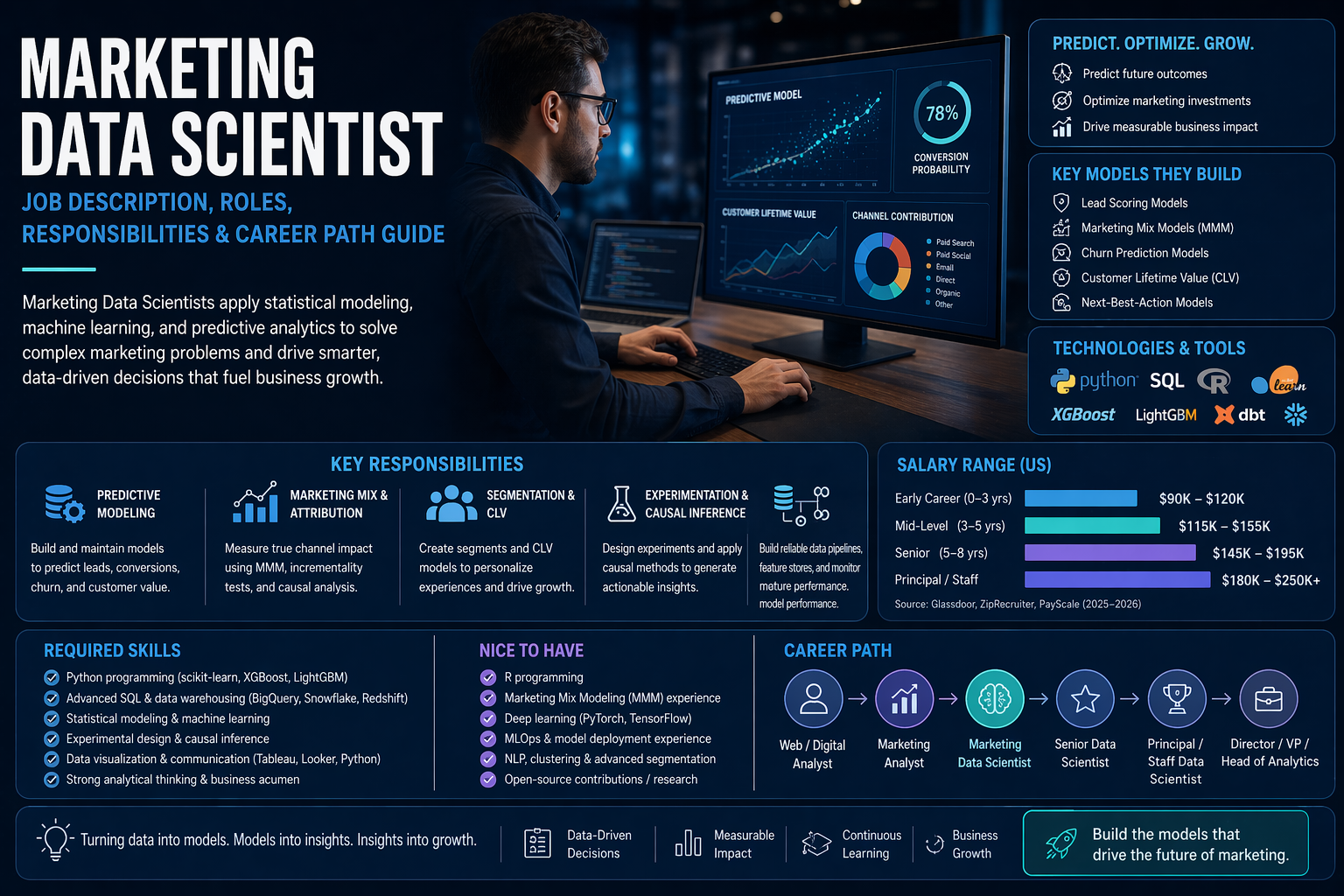
Marketing Data Scientist: Job Description, Roles, Responsibilities & Career Path Guide
A Marketing Data Scientist is a senior analytics professional who applies statistical modeling, machine learning, and predictive analytics to solve marketing problems that go beyond what standard reporting tools can answer. The role combines rigorous quantitative science with applied marketing strategy — building the models, algorithms, and decision frameworks that help organizations predict future outcomes, understand causal relationships, and allocate marketing investment with greater precision.
While a Marketing Analyst measures and interprets historical performance, and a Marketing Analytics Manager designs how measurement gets done at an organizational level, the Marketing Data Scientist builds the predictive and causal models that sit above and behind both — generating intelligence that standard analytics approaches cannot produce on their own.
This is the most technically demanding role in the marketing analytics career ladder and one of the highest-compensated. For organizations with sufficient data volume and analytical maturity, it is also one of the most commercially impactful.
What Does a Marketing Data Scientist Do?
A Marketing Data Scientist applies the scientific method to marketing problems. This means forming testable hypotheses, designing experiments or observational studies to test them, analyzing results with statistical rigor, and communicating conclusions with appropriate confidence levels.
In practice, the Marketing Data Scientist answers a fundamentally different class of questions than the analysts they work alongside. Where analysts answer descriptive and diagnostic questions — what happened and why — the data scientist answers predictive and causal questions:
- Which leads are most likely to convert, and what is the probability estimate behind that prediction?
- Which customers are at risk of churning in the next 90 days, and what intervention is most likely to prevent it?
- What is the true causal contribution of each marketing channel to revenue after controlling for seasonality, pricing changes, and organic demand?
- If paid social budget increases by 20%, what does the model predict will happen to pipeline — and with what confidence?
These are the questions that determine how significant marketing budgets get allocated. The Marketing Data Scientist is the professional with both the technical capability to answer them and the business fluency to communicate answers in terms that drive real decisions.
Marketing Data Scientist Responsibilities
Marketing Data Scientists carry responsibility across five interconnected areas, each requiring a different combination of technical and strategic skill.
Predictive Modeling and Lead Intelligence
- Building and maintaining lead scoring models that rank inbound leads by conversion probability using behavioral signals from web analytics, product usage, email engagement, and CRM data
- Developing propensity models that predict which accounts or contacts are most likely to respond positively to specific marketing interventions — events, content offers, paid campaigns, or direct outreach
- Designing account health models for customer marketing teams that identify expansion opportunity or churn risk before those signals appear in standard dashboards
- Validating model performance over time by tracking accuracy, precision, recall, and lift metrics — and retraining models when performance degrades as market conditions evolve
Marketing Mix Modeling and Attribution Science
- Building or commissioning Marketing Mix Models (MMM) that quantify the contribution of each marketing channel to revenue while controlling for external factors including seasonality, competitor activity, and macroeconomic conditions
- Designing and analyzing incrementality tests — holdout experiments, geo-based matched market tests, and randomized controlled trials — that provide causal evidence of marketing impact beyond what correlation-based attribution models produce
- Evaluating attribution methodology across the organization and recommending improvements as data infrastructure and analytical maturity evolve. This connects directly to the broader questions covered in What Is Campaign Analytics?
- Producing scenario planning models that project marketing outcomes under different budget allocation assumptions — enabling planning conversations that are driven by modeled evidence rather than historical precedent
Customer Lifetime Value and Segmentation Science
- Building customer lifetime value (CLV) models that estimate the long-term revenue contribution of customers acquired through different channels, at different cost levels, enabling more sophisticated acquisition efficiency targets
- Developing statistical segmentation frameworks that identify customer clusters based on behavioral, firmographic, and purchase pattern data — providing the quantitative foundation for the audience strategy that campaign and content teams execute against
- Creating churn prediction models that identify at-risk customers early enough for marketing and customer success interventions to be effective
- Designing next-best-action models that determine which marketing communication or offer is most likely to advance a prospect or customer toward a desired outcome at any given moment in their journey
Experimentation Program and Causal Inference
- Designing statistically valid A/B tests and multivariate experiments for marketing programs — going beyond the basic test setup that a CRO Specialist handles to address complex experimental design questions involving interaction effects, network effects, and low-traffic constraints
- Applying causal inference methods — difference-in-differences, regression discontinuity, instrumental variables — to observational marketing data in cases where controlled experiments are not feasible
- Establishing the organization’s experimentation standards, including power calculation methodology, multiple testing corrections, and early stopping criteria
- Building the institutional knowledge base that turns individual experiment results into accumulated organizational learning
Data Infrastructure and Analytical Enablement
- Collaborating with data engineering teams to define the data requirements — event schemas, entity relationships, data quality standards — that make predictive modeling possible
- Building reusable feature stores and data pipelines that make the inputs to marketing models reliable, consistent, and available to downstream analytical consumers
- Creating model documentation, performance monitoring dashboards, and governance frameworks that ensure models in production remain accurate and trustworthy over time
- Enabling self-service analytical capability across the marketing team by productizing model outputs — lead scores, audience segments, churn probabilities — into tools and dashboards that non-technical stakeholders can use without requiring data science support for every decision
Who Uses Marketing Data Science?
Marketing Data Scientists work across a wide range of organizations and team structures. The role is most common in:
- B2B SaaS and technology companies where customer acquisition costs are high, sales cycles are long, and the commercial value of predictive lead intelligence is immediately measurable
- Enterprise B2B organizations with large marketing budgets where the ROI case for Marketing Mix Modeling and incrementality testing is strong
- E-commerce and direct-to-consumer brands where customer lifetime value modeling and churn prediction drive significant revenue decisions
- Financial services and insurance companies where predictive modeling of customer behavior has deep roots and strong data infrastructure
- Marketing agencies and consultancies that serve clients requiring advanced analytical capability beyond what standard reporting provides
Marketing Data Scientists work most closely with:
- Marketing Analytics Managers and Directors who own the measurement strategy the models serve
- Campaign and demand generation teams who consume model outputs for targeting and budget decisions
- Sales operations and revenue operations teams who use lead scoring and propensity model outputs for pipeline prioritization
- Data engineering teams who build and maintain the infrastructure that makes modeling possible
- Product teams at SaaS companies where marketing and product data overlap in customer journey modeling
Why Marketing Data Science Matters
Marketing data science matters because it addresses the fundamental limitation of standard analytics: correlation is not causation, and historical patterns are not reliable predictors of future outcomes in isolation.
Standard marketing analytics tells organizations what happened. Marketing data science helps them understand why it happened at a causal level, what is likely to happen next, and which actions will produce the best outcomes given current conditions. That distinction has significant commercial consequences:
- More efficient budget allocation. Organizations that use Marketing Mix Modeling to guide budget decisions consistently identify 10–20% of spend that is inefficient and can be reallocated to higher-performing channels without reducing total output
- Higher lead conversion rates. Lead scoring models that accurately predict conversion probability allow sales teams to prioritize effort on the accounts most likely to close, reducing time wasted on low-probability leads
- Lower customer acquisition cost over time. CLV modeling enables more precise CAC targets by acquisition channel, preventing the systematic over-investment in channels that generate volume but not long-term value
- Faster experimentation cycles. Statistical expertise in experiment design ensures that tests are adequately powered, results are correctly interpreted, and learning accumulates at a faster rate than organizations running experiments without rigorous methodology
Marketing Data Scientist Requirements
The Marketing Data Scientist role has the most demanding technical requirements in the analytics career ladder. Organizations hiring for this role expect a specific combination of statistical depth, programming proficiency, and marketing domain knowledge that takes years of deliberate development to build.
Education
- A master’s degree or PhD in statistics, mathematics, computer science, engineering, econometrics, or a related quantitative discipline is the baseline expectation at most enterprise organizations
- A bachelor’s degree combined with demonstrably strong practical experience — a substantive portfolio of models built and deployed in production marketing environments — is accepted at some organizations, particularly in growth-stage companies and agencies
- Relevant coursework in statistical inference, machine learning, causal inference, and experimental design carries more weight than the specific degree title
- Professional development through programs such as Coursera’s machine learning specializations, fast.ai, or CXL’s data science for marketers curriculum can supplement formal education effectively
Technical Skills
The following technical skills are hard requirements in the majority of Marketing Data Scientist job postings:
- Python proficiency — the ability to build, train, validate, and deploy machine learning models using scikit-learn, XGBoost, LightGBM, and related libraries. Python is the lingua franca of marketing data science and non-negotiable at this level
- Advanced SQL — complex query writing against large datasets in cloud data warehouses including BigQuery, Snowflake, or Redshift. The data scientist who cannot work directly with raw warehouse data depends on others for their inputs and is significantly less effective
- Statistical modeling depth — regression analysis, classification models, survival models, time series forecasting, clustering algorithms, and causal inference methods at a level sufficient to choose the right approach for a given problem, implement it correctly, and interpret results with appropriate nuance
- Experimental design expertise — hypothesis testing, power calculation, multiple testing corrections, Bayesian versus frequentist frameworks, and causal inference methodology for observational data settings
- Data visualization and communication — the ability to translate model outputs and statistical findings into clear, stakeholder-facing presentations and dashboards. Proficiency with tools like Tableau, Looker, or Python visualization libraries is expected
Analytical Skills
Beyond technical tools, Marketing Data Scientists need:
- The ability to translate a business problem into a well-specified modeling problem — identifying which question is actually answerable with available data, which modeling approach is appropriate, and what the limitations of the resulting model are
- Statistical humility — the judgment to communicate model uncertainty honestly, flag when a model is operating outside its reliable range, and resist pressure to overstate predictive accuracy
- Domain knowledge in marketing measurement — understanding how marketing data is generated, where it is unreliable, and how measurement frameworks connect to commercial outcomes
- Cross-functional collaboration skills — the ability to work effectively with data engineers on infrastructure requirements, marketing managers on model deployment, and executives on strategic interpretation of findings
Nice to Have
These skills and qualifications appear in senior-level Marketing Data Scientist postings and consistently differentiate candidates at principal and lead levels.
Advanced Technical Skills
- R proficiency — particularly valuable for statistical modeling work, econometric methods, and environments where R-native packages for marketing mix modeling (Robyn, MMM from Google) are in active use
- Causal inference expertise — deep familiarity with methods including propensity score matching, instrumental variables, regression discontinuity, and difference-in-differences beyond textbook understanding
- Deep learning frameworks — PyTorch or TensorFlow familiarity for roles at organizations applying neural network approaches to marketing personalization or content recommendation at scale
- MLOps capability — experience deploying models into production environments using tools like MLflow, Vertex AI, or SageMaker, including monitoring, versioning, and retraining pipelines
- dbt and data pipeline tools — the ability to build and maintain the transformation layers that produce modeling-ready datasets, reducing dependence on data engineering teams for routine data preparation tasks
Domain-Specific Nice to Haves
- Marketing Mix Modeling implementation experience — having built an MMM from scratch using open-source frameworks like Meta’s Robyn or Google’s Meridian is a significant differentiator given the growing organizational appetite for this methodology
- Natural language processing (NLP) — for roles at organizations applying text analysis to customer feedback, support ticket classification, or content performance prediction
- Graph analytics — for roles at organizations modeling referral networks, account relationship structures, or social influence in B2B buying processes
Marketing Data Scientist Salary Range
The Marketing Data Scientist role commands the highest individual contributor salary range in the marketing analytics career ladder, reflecting both the technical scarcity of practitioners who combine statistical depth with marketing domain knowledge and the direct commercial impact of the models they build.
The following figures reflect US market data from Glassdoor, ZipRecruiter, and PayScale as of 2025–2026.
| Experience Level | Salary Range (US) |
|---|---|
| Early career (0–3 years) | $90,000 – $120,000 |
| Mid-level (3–5 years) | $115,000 – $155,000 |
| Senior (5–8 years) | $145,000 – $195,000 |
| Principal / Staff data scientist | $180,000 – $250,000+ |
Glassdoor data shows an average total compensation of $127,220 for Marketing Data Scientist roles as of late 2025, with the typical range spanning $95,415 at the 25th percentile to $172,673 at the 75th percentile, and top earners at the 90th percentile reaching $225,340. ZipRecruiter data for March 2026 places the average at $165,018, with the majority of roles ranging between $133,500 and $170,000.
Key factors that drive salary higher:
- Production ML experience — data scientists who have deployed models into live marketing systems, not just built models in notebooks, command significantly higher compensation
- MMM expertise — Marketing Mix Modeling practitioners are genuinely scarce; organizations with significant media budgets will pay meaningful premiums for this specific capability
- B2B SaaS and technology sector — consistently the highest-paying environment for this role, particularly at growth-stage companies where marketing data science directly influences revenue forecasting
- Location and remote work — major metro markets (San Francisco, New York, Seattle) pay 15–30% above national averages, and remote roles at large technology companies often pay these rates regardless of location
- Research publications or open-source contributions — in some technical hiring environments, demonstrated public contributions to the field signal depth beyond what a resume alone conveys
Marketing Data Scientist Career Path
The Marketing Data Scientist role sits on the advanced specialist track of the analytics career ladder — typically reached after several years of progression through analyst and senior analyst roles, combined with deliberate development of statistical modeling and programming skills.
Paths Into This Role
Most Marketing Data Scientists arrive through one of three routes:
From the analytics track — Marketing Analysts or Web Analysts who developed strong SQL proficiency and analytical skills, then systematically built Python and statistical modeling capability through dedicated learning, side projects, or graduate study while working.
From a quantitative academic background — graduates of statistics, econometrics, applied mathematics, or computer science programs who develop marketing domain knowledge on the job, often starting in general data science roles before specializing in the marketing application domain.
From adjacent data science roles — practitioners who worked in product analytics, business intelligence, or general data science environments and developed marketing domain expertise through exposure to growth, acquisition, or revenue analytics problems.
Career Progression
Web / Digital Analyst (Role 1)
          ↓
Marketing Analyst (Role 2)  +  Statistical modeling development
          ↓
Marketing Data Scientist  ← You are here
          ↓
Senior Marketing Data Scientist
          ↓
Principal / Staff Data Scientist  OR  Head of Marketing Science
          ↓
Director of Analytics / Marketing Analytics Manager (Role 3)
          ↓
VP / Chief Data Officer
Senior Marketing Data Scientists have three primary paths forward depending on their interests and organizational context:
The technical leadership track — moving into Principal or Staff Data Scientist roles with broader organizational scope and deeper technical authority, contributing to modeling standards, hiring decisions, and research agenda across the analytics function.
The management track — transitioning into the Marketing Analytics Manager role or Director of Analytics, expanding from individual modeling contribution to team leadership and measurement strategy ownership. This transition requires developing stakeholder management, people leadership, and communication skills alongside the technical depth.
The product or strategy track — moving into Head of Marketing Science, VP of Growth Analytics, or Director of Decision Science roles that combine technical credibility with organizational influence over how the entire business uses data to make decisions.
Common Misconceptions About This Role
“Marketing data science is the same as marketing analytics.” Marketing analytics and marketing data science are complementary but distinct disciplines. Marketing analytics focuses on measuring and interpreting what happened. Marketing data science focuses on building predictive models, causal inference frameworks, and algorithmic decision systems. Both are necessary; neither substitutes for the other.
“You need a PhD to do this job.” A PhD provides strong preparation for this role but is not a universal requirement. Organizations care more about demonstrated capability — models built, deployed, and validated in production environments — than academic credentials alone. Many successful Marketing Data Scientists hold master’s degrees or bachelor’s degrees combined with strong portfolios of applied work.
“The models do the work.” Models are tools that reflect the quality of the data fed into them, the rigor of the problem formulation, and the judgment of the practitioner who built them. A lead scoring model built on biased training data produces biased scores. An MMM built without appropriate controls produces misleading channel attribution. The data scientist’s judgment — about data quality, model assumptions, and the limits of what any model can reliably predict — is what determines whether the technical output creates business value or false confidence.
“This role is purely technical.” The most effective Marketing Data Scientists spend a significant portion of their time on communication — translating model outputs into strategic recommendations that business stakeholders can act on. A model that produces accurate predictions but cannot be explained to a CMO or a media planning team in comprehensible terms does not change decisions. The ability to bridge technical depth and business communication is as important as the modeling capability itself.
Related Roles in This Series
- Web Analyst: Job Description, Requirements, Role and Career — the foundational analytics role this specialist track builds from
- Marketing Analyst: Job Description, Roles & Responsibilities — the most common path into marketing data science
- Marketing Analytics Manager: Job Description, Roles & Responsibilities — the management track that senior data scientists can transition into
- Campaign Analytics Specialist — the parallel measurement specialist track
Related Articles
- What Is Marketing Analytics? A Complete Guide for Practitioners — the strategic measurement context within which marketing data science operates
- What Is Campaign Analytics? A Complete Guide for Practitioners — how campaign measurement connects to predictive modeling and attribution science
- What Is Web Analytics? A Complete Guide for Practitioners — the behavioral data layer that feeds marketing data science models
- Web Analytics Tools: A Complete Comparison Guide — the tools that generate the behavioral data marketing data scientists work with