


What Is Marketing Attribution? A Complete Guide for Marketing Analytics Practitioners
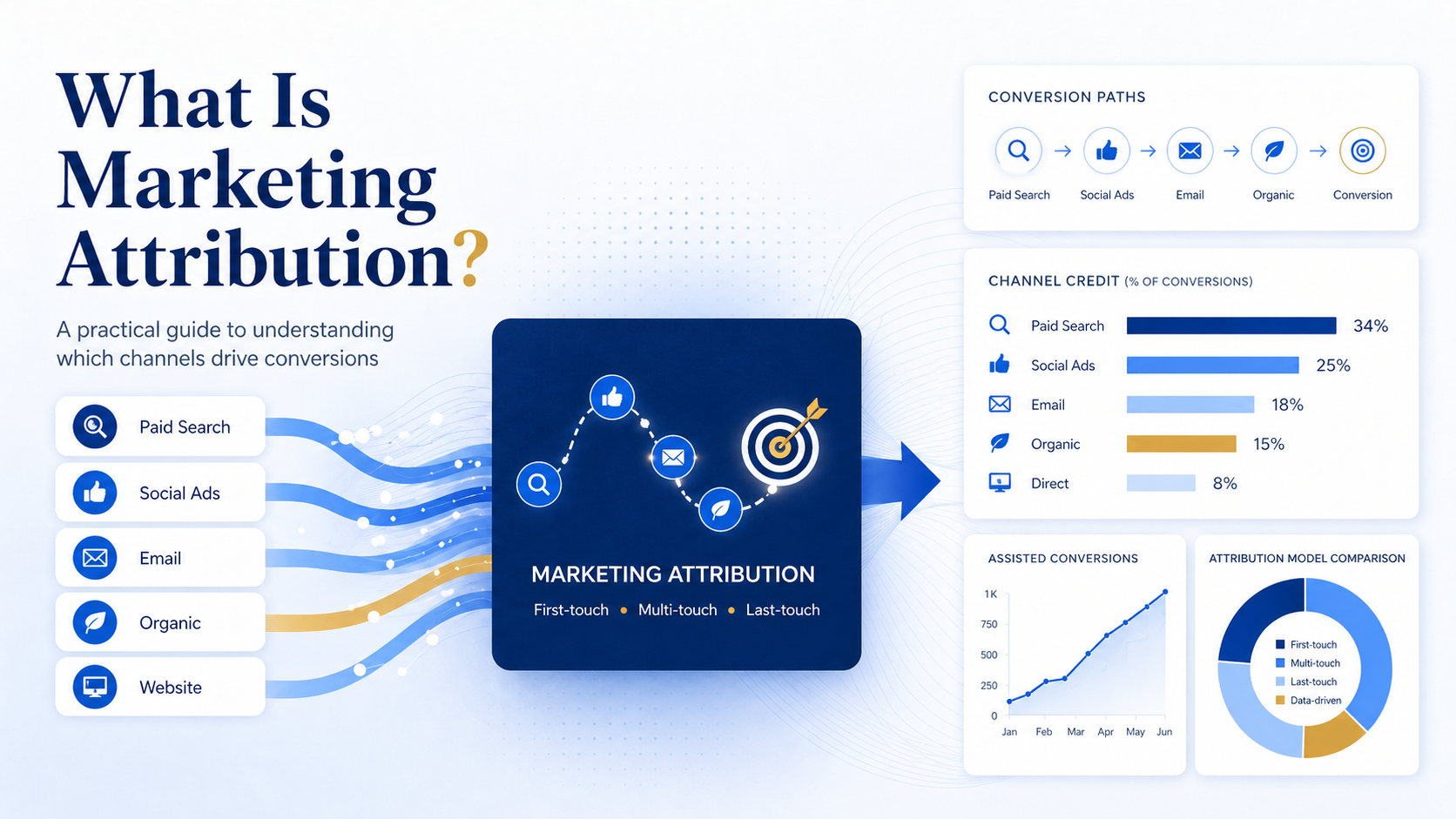
Marketing attribution is the process of identifying which marketing touchpoints contributed to a conversion and determining how much credit each touchpoint deserves. At its core, it answers a deceptively simple question: when a customer buys from you, which marketing activity was responsible?
The reason I say “deceptively simple” is because the actual answer is almost never clean. A B2B buyer who eventually requests a demo might have encountered your brand through an organic search result six months earlier, clicked a LinkedIn sponsored post three months later, attended a webinar you hosted, received a nurture email sequence, and finally clicked a retargeting ad the week they made the decision to engage. Every one of those touchpoints played some role. Marketing attribution is the discipline of figuring out how to assign credit across that journey in a way that reflects reality closely enough to inform useful decisions.
Done well, attribution drives smarter budget allocation, better channel mix decisions, and a more defensible conversation about marketing ROI. Done poorly — which is the norm in most organizations — it produces confident-looking numbers that systematically misdirect investment, consistently overvalue bottom-funnel channels, and fail to capture anything that happens outside the digital tracking perimeter.
If you are building out the analytics function that owns this work, the Marketing Analytics Manager role guide covers what a team capable of running attribution properly looks like. For the broader strategic context of why measurement sits at the center of analytics maturity, my guide to marketing analytics is the right starting point.
Why Attribution Is Harder Than It Looks
Before we get into the mechanics of how attribution works, it is worth being direct about why this problem is genuinely difficult — not because the math is hard, but because the real world does not cooperate with clean measurement.
The multi-touch problem. Modern customer journeys involve many interactions across many channels, often spanning weeks or months. Deciding which of those interactions deserves credit, and how much, is an inherently arbitrary question. There is no objective ground truth. Any attribution model reflects a set of assumptions about how influence works, and those assumptions can be more or less reasonable but never definitively correct.
The tracking gap. Every attribution system can only give credit to touchpoints it can observe. A customer who saw your TV ad, heard your podcast sponsorship, noticed your billboard during their commute, and then Googled your brand name to convert — your digital attribution system will give 100% of the credit to branded search, because that is the only touchpoint it saw. The offline influences that drove the brand search are completely invisible. As third-party cookies erode and privacy regulations tighten, this gap is growing even for digital channels.
The incrementality problem. Attribution models tell you which touchpoints appeared in conversion paths. They do not tell you whether those touchpoints caused the conversion. A customer who was going to convert anyway, who clicked a retargeting ad on the way to typing your URL directly, will show up in attribution reports as a retargeting conversion. That click was not incremental — the sale would have happened without it — but last-click attribution reports it as a full attribution credit. This is the core reason why platform-reported ROAS consistently overstates true marketing effectiveness.
Platform double-counting. Every ad platform runs its own attribution model using its own conversion window. When Google Ads, Meta, LinkedIn, and your email platform each report conversions for the same sale, total attributed revenue routinely exceeds actual revenue. This is not fraud — it is the natural result of multiple platforms each claiming credit under their own models. An analyst who adds up platform-reported conversions without cross-referencing to actual revenue will arrive at a deeply misleading picture of marketing performance.
Understanding these limitations is not an argument against doing attribution. It is an argument for doing attribution with appropriate skepticism about what any single model can tell you, and for building a measurement stack that triangulates across methods rather than relying on one approach.
The Major Attribution Models Explained
Attribution models are the rules that govern how conversion credit gets distributed across touchpoints. Each model makes different assumptions about where influence is concentrated in the customer journey.
Last-click attribution assigns 100% of the conversion credit to the final touchpoint before the conversion. It is simple, easy to implement, and built into most analytics platforms as the default. It is also systematically wrong for any customer journey with multiple touchpoints, because it gives zero credit to every channel that built awareness and consideration, and gives all credit to the channel that happened to be last. In B2B contexts with long sales cycles, last-click attribution is particularly misleading — it will consistently overvalue retargeting and branded search while undervaluing content, social, and display channels that drove early-stage awareness.
First-click attribution is the mirror image — it assigns 100% of the credit to the first touchpoint in the customer journey. This is useful if you are specifically trying to understand which channels are best at generating new audience awareness, but it ignores all the nurturing activity that moved the prospect from initial awareness to conversion readiness.
Linear attribution distributes conversion credit equally across all touchpoints in the journey. A customer with five touchpoints gives 20% credit to each. This is more honest about the reality that multiple touchpoints contribute, but the equal weighting is arbitrary — it assumes that a first impression and a final retargeting click made equivalent contributions, which is rarely true.
Time-decay attribution gives more credit to touchpoints that occurred closer in time to the conversion, with credit diminishing exponentially as you go further back in the journey. This reflects the intuition that recent touchpoints are more relevant to the conversion decision. It is a reasonable model for short sales cycles but systematically undervalues brand-building activity in longer B2B cycles.
Position-based attribution (also called U-shaped attribution) gives 40% of credit to the first touchpoint, 40% to the last touchpoint, and distributes the remaining 20% equally across middle touchpoints. This reflects the practical reality that many teams care most about the awareness-generating and conversion-driving moments, while still acknowledging middle-funnel contribution. W-shaped attribution extends this by also crediting the lead creation touchpoint, making it a common choice for B2B teams with defined pipeline stages.
Data-driven attribution uses machine learning to analyze your actual conversion path data and estimate the causal contribution of each touchpoint. Instead of applying fixed rules, it looks at which paths tend to produce conversions versus which do not, and infers channel contribution from those patterns. Google Analytics 4 offers data-driven attribution as its default model for users with sufficient conversion volume. It is the most sophisticated rule-based approach, but it still operates only on observable digital touchpoints, shares the same tracking gap limitations as other digital attribution methods, and requires substantial conversion volume to produce stable estimates.
Attribution Models in Practice: What Each One Gets Right and Wrong
Choosing an attribution model is really a choice about which business question you are trying to answer. No single model answers all questions well, and the right approach for budget allocation decisions is almost certainly different from the right approach for campaign optimization decisions.
If you are trying to understand which channels drive new customer acquisition, first-click or a position-based model that weights the first touchpoint heavily will give you more useful signal than last-click. If you are optimizing a direct response campaign where the purchase decision happens quickly after the final touchpoint, last-click or time-decay may be sufficient for tactical decisions even if they are theoretically impure. If you need to justify marketing investment to a CFO by demonstrating incremental contribution to revenue, neither model will be convincing without incrementality test data to validate it.
The practical guidance I give analytics teams is to use last-click or data-driven attribution for tactical channel and campaign optimization within digital, because those platforms already run on last-click logic and changing the model for in-platform decisions creates confusion. But use a multi-touch model — or better, combine MTA with marketing mix modeling — for strategic budget allocation and cross-channel ROAS comparison. The campaign analytics guide on this site covers the tactical measurement layer in more detail.
Attribution in B2B Contexts: What Changes
B2B attribution has specific characteristics that make the standard digital attribution playbook significantly less applicable.
The sales cycle is long. B2B purchases often take three to twelve months from first awareness to closed deal, and the touchpoints that matter happen across a timeline that breaks most attribution window settings. Standard Google Analytics attribution windows cap out at ninety days, which means any awareness activity that influenced a B2B buyer in the first half of their consideration journey is invisible to your attribution reports by the time they convert.
There are multiple decision-makers. B2B purchases involve buying committees — economic buyers, technical evaluators, end users, procurement — who each interact with marketing content independently. Standard attribution tracks cookies or sessions, which means a procurement specialist clicking an ad and a VP clicking a whitepaper both look like separate individual journeys even though they are part of the same purchase decision. Account-based attribution, which aggregates touchpoint data at the company level rather than the individual level, addresses this problem but requires CRM integration and more sophisticated analytics infrastructure than most organizations have in place.
Offline touchpoints matter more. Field events, executive dinners, direct mail, trade shows, and sales development outreach all play roles in B2B pipeline that digital attribution cannot capture. The gap between what is attributed and what actually influenced the sale is larger in B2B than in most B2C contexts.
For the B2B analytics practitioner, this means treating digital attribution as a partial and imperfect signal rather than an accurate measurement of marketing contribution. The metrics that matter most are pipeline influence (how much pipeline did this channel touch, at what stages), conversion rate by source (which channels produce opportunities that actually close), and time-to-close by acquisition channel (do customers from certain channels close faster or slower). These require CRM integration and analyst effort, but they give you a more honest picture of B2B marketing performance than any of the standard attribution models.
Building an Attribution Measurement Stack
A robust attribution capability is not a single tool — it is a combination of approaches that triangulate toward a more accurate picture than any one method could provide.
Layer one: Digital attribution in your analytics platform. GA4 with data-driven attribution connected to your conversion events provides your day-to-day operational view of digital channel performance. This is where you monitor campaign performance, identify channel trends, and make tactical optimizations. Accept that it is incomplete and directionally useful rather than definitively accurate. The web analytics guide on this site covers the GA4 and web measurement layer in detail.
Layer two: Cross-channel attribution with first-party data. If you have sufficient volume and technical capability, building a multi-touch attribution model on your own first-party data — combining CRM records, marketing automation data, and web analytics — gives you channel contribution estimates that are not dependent on any single platform’s attribution logic and are not subject to the cross-platform double-counting problem. This is what marketing technology platforms like Northbeam, Triple Whale, and Rockerbox are selling: an independent attribution layer built on your first-party event data.
Layer three: Marketing mix modeling for strategic allocation. As covered in the marketing mix modeling guide, MMM operates at an aggregate level and captures offline channels, brand effects, and channel interactions that digital attribution cannot see. What Is Marketing Mix Modeling covers this layer in full. MMM is the strategic complement to the tactical picture digital attribution provides.
Layer four: Incrementality testing for ground truth. Neither digital attribution nor MMM tells you definitively whether your marketing caused conversions — they tell you which channels appeared in paths or correlate with outcomes. Incrementality tests, run as controlled experiments by geo, audience segment, or time period, measure the causal lift from specific marketing activities. They are the closest thing to ground truth measurement that exists in marketing, and they are what you use to validate the coefficients your MMM produces and pressure-test the ROAS numbers your digital attribution reports.
The Attribution Data Infrastructure You Actually Need
Getting attribution right requires more than choosing the right model — it requires the underlying data infrastructure to make any model trustworthy.
UTM parameter governance is foundational and chronically neglected. If your campaign tracking parameters are inconsistent — mixed naming conventions, missing parameters on some campaigns, parameters that got broken during a website migration — your attribution reports are garbage regardless of which model you use. Every paid campaign should have standardized UTM parameters applied at launch, validated before spend goes live, and audited quarterly. This is unglamorous work, but it is the prerequisite for everything else. If you are building the team to own this infrastructure, the Campaign Analytics Specialist role is the profile that typically owns tracking governance.
CRM and marketing automation integration matters for any organization with a sales cycle longer than a few days. Your analytics platform tracks what happens on your website. Your CRM tracks what happens after the web conversion, through the sales process, and into customer lifecycle. Connecting these systems — so that you can trace a web visit through to a closed deal and attribute revenue to the originating marketing source — is what makes B2B attribution meaningful rather than a measure of vanity metrics.
Server-side event tracking is increasingly important as client-side tracking degrades. When browsers block third-party cookies and extensions prevent JavaScript from firing, client-side analytics miss events. Server-side tagging sends tracking data directly from your server to analytics platforms, independent of browser behavior. Google Tag Manager supports server-side containers. Implementing it for your most important conversion events significantly improves the accuracy of your attribution data, particularly for users on browsers with aggressive privacy defaults.
Attribution window standardization is a decision that sounds technical but is really a business decision. What is the maximum time you believe your marketing can influence a purchase decision? Setting a ninety-day attribution window in GA4 and a thirty-day window in your ad platforms and a fourteen-day window in your email platform means you are comparing channels against different standards. Standardizing attribution windows across your measurement systems, even if the standard you choose is imperfect, gives you apples-to-apples channel comparisons.
What Good Attribution Looks Like in Practice
A mature attribution practice does not produce a single definitive answer to “which channel is responsible for this sale.” It produces a structured conversation, informed by multiple measurement approaches, that gets progressively closer to the truth.
That conversation starts with consistent digital attribution as the baseline operational view. It incorporates periodic MMM refreshes that provide aggregate, privacy-safe channel ROAS estimates. It runs incrementality tests on the channels where the spend is large enough that a precise causal estimate is worth the cost of designing and running the experiment. It triangulates across these three sources, looking for patterns that are consistent across methods and flagging discrepancies that suggest a model is misbehaving.
The Director of Marketing Analytics who builds this infrastructure is the person who can walk a CMO through the limitations of each measurement layer and explain why the company should trust the triangulated view rather than the platform dashboard number. That conversation — connecting measurement methodology to business decision-making — is what separates a mature marketing analytics function from a team that reports numbers without understanding what they mean.
Attribution is not a solved problem, and anyone who tells you otherwise is selling something. The goal is not perfect attribution — it is attribution that is good enough to make better decisions than you would make without it, and honest enough that you know which decisions to trust and which to hold lightly.
Further Reading
From this site:
- What Is Marketing Mix Modeling? A Complete Guide
- What Is Marketing Analytics? A Complete Guide for Practitioners
- What Is Campaign Analytics? A Complete Guide for Practitioners
- What Is Web Analytics? A Complete Guide for Practitioners
- Campaign Analytics Specialist: Job Description, Roles & Career Path
- Marketing Analytics Manager: Job Description, Roles & Career Path
External resources: