


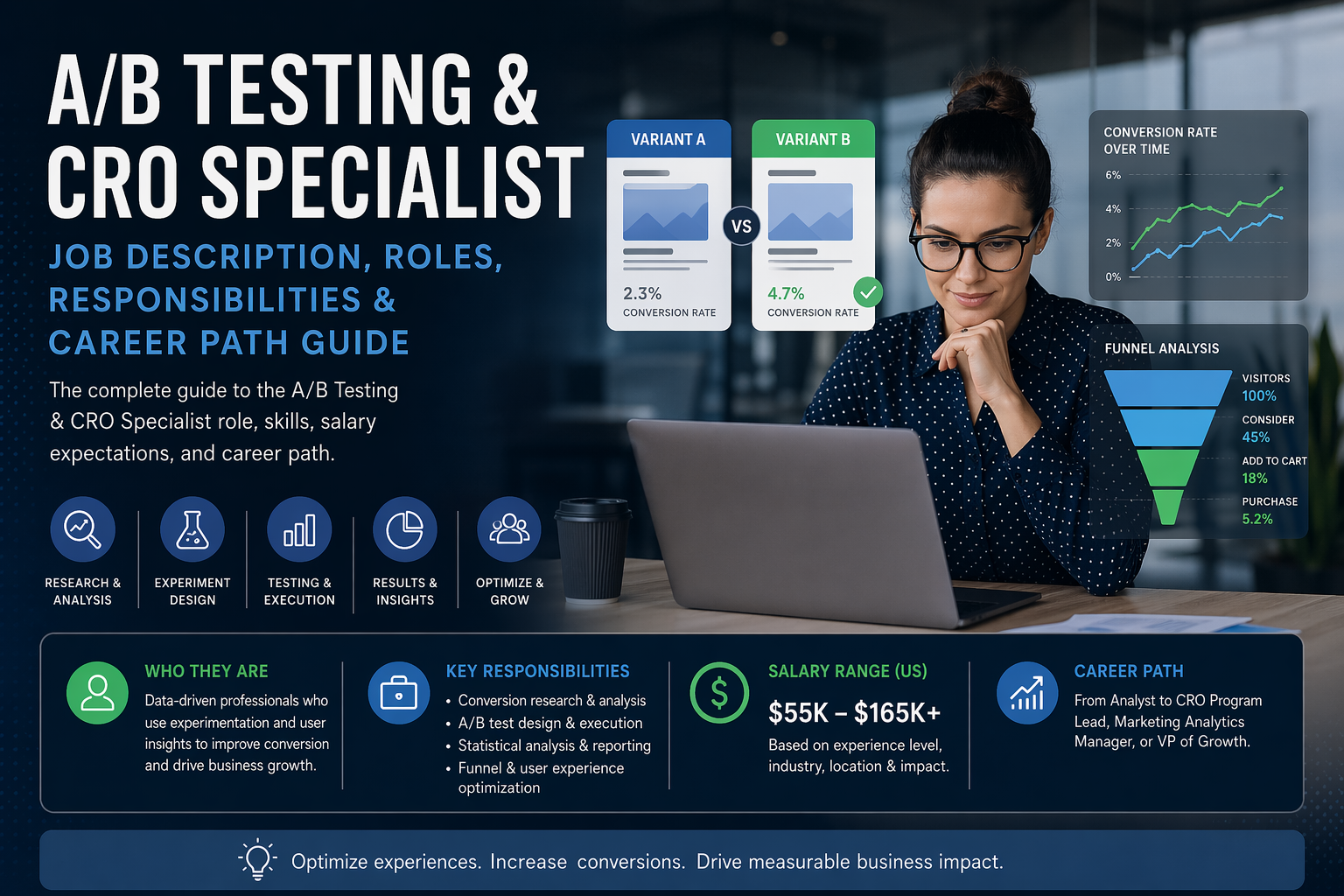
A/B Testing & CRO Specialist: Job Description, Roles, Responsibilities & Career Path Guide
An A/B Testing and Conversion Rate Optimization (CRO) Specialist is a marketing analytics professional who designs, executes, and analyzes controlled experiments to improve how digital properties convert visitors into leads, customers, or other valuable actions. The role combines statistical rigor with UX intuition, behavioral psychology, and a genuine obsession with understanding why people do — and do not — take the actions a business wants them to take.
Where a Marketing Analyst measures what happened across marketing channels, and a Campaign Analytics Specialist evaluates whether campaigns delivered their intended results, the CRO Specialist focuses specifically on improving the conversion efficiency of the digital experience itself — the website, landing pages, forms, funnels, emails, and onboarding flows that turn marketing-generated traffic into measurable business outcomes.
This role has grown significantly in strategic importance over the last five years. Customer acquisition costs have risen sharply across most digital channels, making the economics of conversion optimization increasingly attractive: improving conversion rate from 2% to 3% on the same traffic delivers 50% more output from the same investment. Organizations that understand this math invest seriously in CRO capability. Those that do not continue paying more and more for traffic that converts at the same mediocre rate.
What an A/B Testing & CRO Specialist Actually Does
The title suggests the job is primarily about running A/B tests. It is not — at least not for strong practitioners.
Running an A/B test is straightforward. Any analyst with access to Optimizely or VWO and a basic understanding of split URL testing can launch a test in an afternoon. The hard part — the part that determines whether CRO creates real business value or just generates a stream of statistically inconclusive experiments — is everything that happens before and after the test runs.
Before the test: understanding what the actual conversion problem is, forming a specific hypothesis about why visitors are not converting, identifying which element to test and why, calculating whether the site has enough traffic to run a valid experiment, and designing a test that can actually answer the question it is supposed to answer.
After the test: interpreting the results correctly, understanding when a lift is statistically meaningful versus coincidental, communicating findings to stakeholders in a way that produces action rather than skepticism, and extracting organizational learning that improves future decisions — not just the one page that was tested.
The CRO Specialists who generate the most value spend the majority of their time on the diagnostic work and the institutional learning. The test itself is almost the easy part.
Typical Responsibilities
These are the core responsibilities I see appearing consistently across A/B Testing and CRO Specialist job postings across e-commerce, SaaS, B2B demand generation, and agency environments.
Conversion Research and Diagnostic Analysis
- Conducting quantitative analysis of website and landing page performance using web analytics platforms — identifying pages with high exit rates, low engagement, poor scroll depth, and conversion funnel drop-off points that signal optimization opportunities
- Running qualitative research to understand the behavioral and psychological reasons behind conversion friction — session recording analysis, heatmap interpretation, on-page survey design, and user interview synthesis
- Performing heuristic evaluations of landing pages, checkout flows, and lead capture forms against established UX and conversion best practices
- Building and prioritizing the testing backlog — a structured list of optimization hypotheses ranked by estimated impact, implementation effort, and traffic availability for valid testing
Experiment Design and Execution
- Designing A/B tests, multivariate tests, and split URL tests with clearly defined hypotheses, success metrics, and minimum detectable effect calculations
- Calculating the statistical sample size and test duration required to achieve valid results at the desired confidence level before any test launches
- Implementing test variations using experimentation platforms such as Optimizely, VWO, Adobe Target, or AB Tasty — either directly in the platform’s visual editor or in coordination with front-end developers for more complex implementations
- Managing the active test queue — monitoring tests for data quality issues, early stopping concerns, and implementation errors during the test period
- Conducting quality assurance on test implementations to ensure variations render correctly across devices, browsers, and audience segments
Statistical Analysis and Results Interpretation
- Analyzing test results using appropriate statistical frameworks — frequentist significance testing, Bayesian probability, or sequential testing depending on the organization’s methodology and traffic volume
- Distinguishing between statistically significant results and practically meaningful ones — a 0.3% lift at 95% confidence is technically significant but may not justify implementation cost
- Identifying segmentation opportunities within test results — understanding whether a winning variation performs differently across device types, acquisition channels, or user segments that might inform more targeted personalization strategies
- Producing post-test reports that document methodology, results, interpretation, and actionable recommendations in a format stakeholders across UX, product, and marketing can use
Conversion Funnel Analysis and Optimization
- Mapping and analyzing multi-step conversion funnels — from first page visit through form submission, product consideration, checkout, and post-conversion onboarding — to identify the highest-impact optimization opportunities across the full journey
- Working with the web analytics data layer to build custom funnel reports that surface drop-off patterns invisible in standard platform reporting
- Collaborating with content, design, and UX teams to develop and test conversion-focused copy, visual hierarchy improvements, form optimizations, and CTA variants
- Analyzing how traffic source and campaign performance affects on-site conversion behavior — visitors from different channels convert at different rates for different reasons, and the CRO specialist connects those patterns to optimization strategy
Personalization and Audience Targeting
- Designing audience-specific experiences for high-value visitor segments — returning visitors, visitors from specific industries or account types in B2B contexts, or users in specific stages of the buying journey
- Developing behavioral targeting rules that serve contextually relevant content or CTAs based on real-time session signals
- Collaborating with marketing and analytics teams to activate audience segments identified through marketing analytics into personalized on-site experiences
Reporting and Stakeholder Communication
- Maintaining a testing program dashboard that tracks experiment velocity, win rate, cumulative conversion lift, and projected revenue impact
- Presenting test results and optimization roadmap updates to marketing leadership and cross-functional stakeholders in regular review cadences
- Building the organizational case for sustained CRO investment by connecting optimization outcomes to revenue and pipeline metrics that executive stakeholders care about
Requirements
These are the hard requirements I see appearing in the majority of A/B Testing and CRO Specialist job postings. The role requires a specific combination of statistical capability, platform fluency, and analytical creativity that takes deliberate effort to develop.
Education
- Bachelor’s degree in marketing, statistics, psychology, economics, computer science, or a related field
- Equivalent practical experience with a strong portfolio of documented optimization work is accepted at many organizations — particularly in digital-first and e-commerce environments where hands-on testing experience outweighs formal credentials
- Certifications from CXL Institute, Conversion XL, or platform-specific certifications from Optimizely or VWO carry meaningful weight in this specialist role
Technical Skills
- Experimentation platform proficiency — hands-on experience with at least one major A/B testing platform: Optimizely, VWO, Adobe Target, AB Tasty, or similar. Understanding how the platform handles traffic allocation, statistical calculations, and segment filtering is essential, not optional
- Web analytics fluency — advanced proficiency with Google Analytics 4, including funnel analysis, behavioral segmentation, and the ability to connect experiment traffic to conversion outcomes. Candidates who rely on platform-native reporting without cross-referencing GA4 data systematically miss important context about their test results
- Statistical fundamentals — hypothesis testing, p-values, confidence intervals, statistical power, and sample size calculation at a working level. The CRO specialist who cannot calculate whether their site has enough traffic to run a valid test is a liability rather than an asset
- Qualitative analytics tools — hands-on experience with Hotjar, Microsoft Clarity, FullStory, or similar session recording and heatmap platforms. Quantitative data identifies where the conversion problem is; qualitative data explains why it exists
- Basic HTML and CSS — enough front-end fluency to implement simple test variations in a visual editor, understand what a developer needs to implement more complex changes, and troubleshoot rendering issues in live tests
- Spreadsheet expertise — advanced Excel or Google Sheets skills for sample size calculations, results analysis, test backlog management, and impact projection modelling
Analytical Skills
- The ability to form a testable hypothesis from a behavioral data signal — moving from “exit rate is high on this page” to “visitors are leaving because the CTA is below the fold and the headline does not match the ad they clicked” is the core analytical skill this role requires
- Statistical literacy sufficient to recognize when a test result is genuinely significant versus when it reflects random variation, and the intellectual honesty to communicate the difference clearly even when stakeholders want a winner
- Comfort with ambiguity — CRO work frequently produces inconclusive results, and the ability to extract learning from a null result rather than declaring it a failure is a genuine differentiator
Soft Skills
- Cross-functional collaboration — CRO sits at the intersection of analytics, UX, content, development, and marketing. The specialist who cannot work effectively across all four disciplines consistently underdelivers
- Persuasion and stakeholder management — getting tests built and launched requires influencing product managers, developers, and design teams who have competing priorities. This is a political skill as much as a technical one
- Intellectual curiosity about human behavior — the best CRO practitioners are genuinely fascinated by why people make the decisions they make online. That curiosity drives better hypothesis formation than any technical skill
Nice to Have
These skills appear in a meaningful share of senior CRO specialist and lead experimentation roles and consistently accelerate progression from specialist to program lead level.
Technical Nice to Haves
- JavaScript proficiency — the ability to implement test variations directly in code, build custom event tracking for experiments, and diagnose front-end issues without developer dependency. JavaScript fluency separates CRO specialists who can run any test they design from those who are limited to what a visual editor can implement
- SQL — the ability to query raw behavioral event data from a data warehouse to build custom funnel analyses and segment test results beyond what analytics platforms expose natively. As organizations move toward warehouse-native analytics stacks, SQL fluency becomes increasingly valuable even in CRO-focused roles
- Python or R — statistical analysis beyond what spreadsheets support, including Bayesian A/B test analysis, multi-armed bandit simulations, and sequential testing frameworks
- CDP and personalization platform experience — familiarity with how platforms like Segment, Tealium, or Dynamic Yield enable audience-based personalization at a scale that standard A/B testing tools cannot reach
- Landing page platform expertise — proficiency with Unbounce, Instapage, or similar landing page builders that campaign teams use for paid media destination pages, which are frequently high-priority CRO targets
Analytical Nice to Haves
- Bayesian statistics — understanding of Bayesian A/B testing methodology as an alternative to frequentist significance testing, including when Bayesian approaches produce better decisions for low-traffic properties or tests with asymmetric risk profiles
- Multi-armed bandit methodology — understanding of adaptive testing approaches that reallocate traffic dynamically toward better-performing variants during the test, rather than waiting for a predetermined sample size
- User research methodology — the ability to design and run moderated usability sessions, unmoderated remote tests, and card sorting exercises that generate qualitative insight to inform test hypotheses
Industry-Specific Nice to Haves
- E-commerce funnel expertise — for retail and DTC roles, deep familiarity with product listing page, product detail page, cart, and checkout optimization patterns and the specific behavioral signals that indicate friction in each stage
- B2B lead generation experience — for B2B SaaS and demand generation roles, experience optimizing landing pages, demo request forms, and gated content offers for professional audiences with longer consideration cycles and higher friction tolerance than consumer purchasers
- Email optimization — experience designing and analyzing A/B tests within email marketing platforms, including subject line testing, send time optimization, and content variant testing that feeds into overall funnel performance
Salary Range
CRO and A/B testing specialist roles show meaningful salary variation based on how the role is scoped — whether it is focused primarily on running tests within a CMS or experimentation platform, or whether it encompasses full program ownership including statistical methodology, qualitative research, and executive reporting.
The following figures reflect US market data from Glassdoor, ZipRecruiter, and industry benchmarks as of 2025–2026.
| Experience Level | Salary Range (US) |
|---|---|
| Entry level (0–2 years) | $55,000 – $75,000 |
| Mid-level specialist (2–4 years) | $75,000 – $105,000 |
| Senior specialist (4–7 years) | $100,000 – $135,000 |
| Lead / Principal / Program owner | $125,000 – $165,000+ |
Glassdoor data shows an average total compensation of $89,574 for CRO Analyst roles and $93,894 for Senior CRO Analyst roles as of early 2026. Industry benchmarks from CXL and conversion optimization communities suggest senior program owners at enterprise organizations and high-growth SaaS companies consistently reach $130,000–$165,000.
Factors that push salary significantly higher:
- Revenue attribution capability — specialists who can directly connect their optimization program to incremental revenue command the strongest compensation. If you can say “our CRO program generated $2.4M in incremental revenue last year and here is the methodology,” you negotiate from a very different position than specialists who can only report test win rates
- JavaScript proficiency alongside statistical expertise — this combination enables a specialist to both design and implement complex test variations without developer dependency, dramatically increasing testing velocity and organizational value
- B2B SaaS and high-growth technology environments consistently outpay equivalent CRO roles in retail or agency settings
- Program ownership — managing a testing backlog, an experimentation roadmap, and cross-functional stakeholder relationships rather than executing within a defined program structure
- Remote roles at large technology companies that pay major metro rates regardless of location
Factors that pull salary lower:
- Roles scoped primarily around test execution within predefined programs rather than hypothesis generation, statistical methodology, and program strategy
- Agency environments where billing constraints limit compensation relative to in-house roles of equivalent complexity
- Organizations with low website traffic where testing velocity is inherently constrained and the role’s impact ceiling is lower
Outside the US, equivalent roles typically range from £38,000–£72,000 in the UK and €42,000–£78,000 across major Western European markets, with significant variation by city and sector.
Career Path
The A/B Testing and CRO Specialist sits on a specialist track that branches from the core analytics practitioner ladder. Understanding the paths into and out of this role helps practitioners make intentional decisions about where they want their career to go.
Paths Into This Role
Most CRO specialists arrive from one of three backgrounds:
From the analytics track — Marketing Analysts or Web Analysts who developed a strong interest in behavioral analysis and conversion optimization while working with funnel data, and moved into dedicated CRO roles to go deeper on that specific problem.
From the UX or product side — UX researchers, product designers, or product managers who developed strong analytical skills alongside their design and research capabilities and moved into optimization roles that combine both disciplines.
From the digital marketing side — paid media managers or content marketers who became fascinated by landing page performance and post-click conversion, built testing skills alongside their channel expertise, and transitioned into specialist CRO roles as their interest in measurement grew.
Paths Forward
Web / Digital Analyst (Role 1)
         ↓
Marketing Analyst (Role 2)
         ↓
A/B Testing & CRO Specialist  ← You are here
         ↓
Senior CRO Specialist / Lead Experimentation Analyst
         ↓
Head of Experimentation / Director of CRO
         ↓
Marketing Analytics Manager (Role 3)  OR  VP of Growth / VP of Product
Senior CRO specialists have three distinct forward paths depending on their interests:
The analytics management track — expanding scope beyond experimentation into full marketing analytics program ownership and eventually the Marketing Analytics Manager role. This path requires developing team leadership and broader measurement strategy skills alongside the CRO specialty.
The growth track — moving into VP of Growth or Head of Growth roles that combine acquisition analytics, retention analysis, and conversion optimization into a unified growth function. This path suits specialists who want to extend their conversion expertise across the full customer lifecycle rather than staying focused on website optimization.
The product track — moving into product analytics or product management roles where experimentation methodology is applied to product feature development rather than marketing conversion. This is a natural path for CRO specialists who developed strong product intuition alongside their analytical skills.
Common Misconceptions About This Role
“CRO is just A/B testing.” A/B testing is the primary measurement method CRO uses. The actual discipline is much broader — it encompasses behavioral research, hypothesis development, statistical methodology, UX evaluation, copy optimization, and the organizational work of building an experimentation culture that sustains testing velocity over time. Specialists who define themselves only as “A/B testers” consistently underdeliver against what the role is capable of producing.
“More tests equal more results.” Testing velocity matters, but testing quality matters more. An organization running 50 poorly designed tests per year with inconclusive results learns less and improves less than one running 12 carefully designed tests with clear hypotheses and sufficient statistical power. The best CRO programs prioritize test quality over test quantity.
“A winning test means you understand why it won.” Statistical significance tells you that an effect probably exists. It does not tell you why the variation performed better. The post-test analysis that connects the result to a behavioral insight — why this change resonated with this audience — is what turns a single test win into a repeatable optimization framework. Specialists who skip this step accumulate wins without building knowledge.
“You need a huge website to do meaningful CRO.” Low-traffic sites cannot run statistically valid A/B tests on every page. But they can do qualitative research, heuristic evaluation, and expert review that produce conversion improvements without requiring controlled experiments. CRO is a discipline that scales up and down with traffic availability — not a tool that only works above a specific traffic threshold.
Related Roles in This Series
- Web Analyst: Job Description, Requirements, Role and Career — the foundational analytics role this specialist path builds on
- Marketing Analyst: Job Description, Roles & Responsibilities — the generalist track that feeds into CRO specialization
- Campaign Analytics Specialist — the parallel specialist track focused on paid media measurement and attribution
- Marketing Analytics Manager — the management track that senior CRO specialists can progress into
Related Articles
- What Is Web Analytics? A Complete Guide for Practitioners — the measurement foundation that CRO depends on for behavioral data and funnel analysis
- What Is Campaign Analytics? A Complete Guide for Practitioners — how campaign performance data connects to on-site conversion optimization
- What Is Marketing Analytics? A Complete Guide for Practitioners — the strategic measurement context within which CRO programs operate
- Web Analytics Tools: A Complete Comparison Guide — the tools CRO specialists use daily for behavioral data and session analysis