


Campaign Analytics Specialist: Job Description, Roles, Responsibilities & Career Path Guide
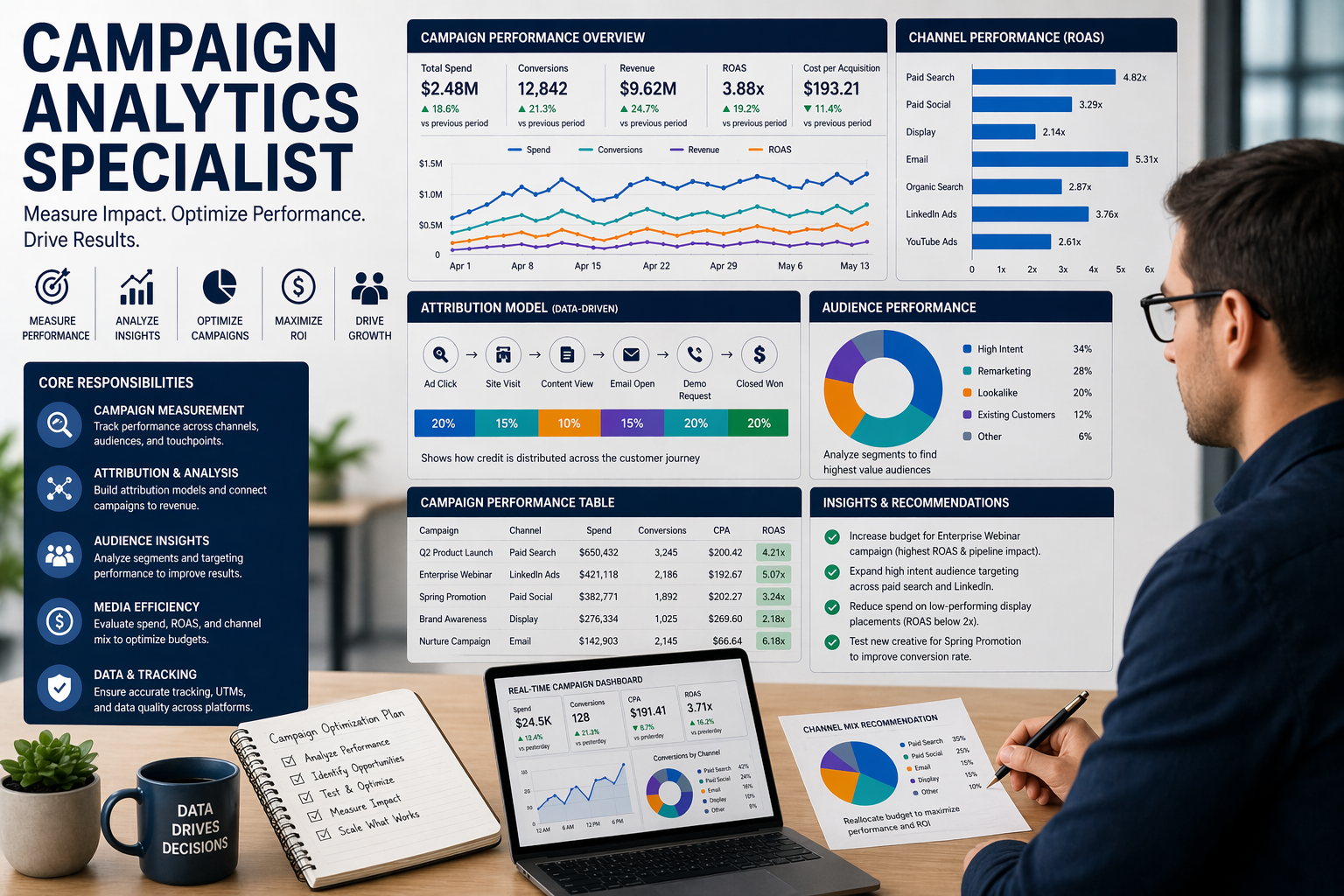
A Campaign Analytics Specialist is a marketing data professional who focuses exclusively on measuring, analyzing, and optimizing the performance of marketing campaigns across paid, owned, and earned channels. Where a Marketing Analyst covers the full breadth of marketing performance measurement, the Campaign Analytics Specialist goes deep — developing expert-level capability in attribution modeling, media efficiency analysis, audience performance evaluation, and the closed-loop measurement that connects campaign spend to revenue outcomes.
This is one of the fastest-growing specialist roles in marketing analytics. The post-cookie measurement environment, the rise of multi-channel B2B buying journeys, and the increasing executive pressure to demonstrate marketing ROI have all combined to create strong and sustained demand for practitioners who can measure campaigns with precision and translate that measurement into actionable budget decisions.
What a Campaign Analytics Specialist Does
The Campaign Analytics Specialist role exists because campaign measurement has become genuinely complex — complex enough that organizations with significant media budgets need dedicated specialists rather than analysts splitting their time across multiple measurement domains.
The specialist operates at the intersection of three disciplines: media measurement, statistical analysis, and business communication. They need to understand how each advertising platform measures its own performance, why those measurements are often inconsistent or misleading when taken at face value, and how to build a measurement framework that gives the business a reliable view of what is actually working.
The most important thing I observe about strong Campaign Analytics Specialists is that they are skeptical of the numbers their own campaigns produce. Platform-reported ROAS is almost always higher than actual ROAS. Last-click conversion counts double-count conversions that multiple channels influenced. They know where the measurement breaks down and they design their analytical approach around those limitations rather than ignoring them.
Typical Responsibilities
These are the responsibilities that appear consistently across Campaign Analytics Specialist job postings across industries and organization types.
Campaign Performance Measurement
- Designing and maintaining the measurement framework for all active marketing campaigns — defining success metrics, conversion events, and reporting standards before campaigns launch rather than after they close
- Building and maintaining campaign performance dashboards in Tableau, Power BI, Looker Studio, or platform-native tools that give campaign teams real-time visibility into key performance indicators
- Producing regular campaign performance reports that go beyond platform-level metrics to show cross-channel performance, audience-level efficiency, and contribution to pipeline and revenue
- Monitoring campaign pacing — tracking spend rates, impression delivery, and conversion velocity against targets and flagging deviations that require tactical intervention
- Conducting in-flight campaign analysis that enables optimization decisions during active campaign periods rather than only post-campaign retrospectives
Attribution and Multi-Touch Analysis
- Owning the organization’s campaign attribution methodology — choosing, implementing, documenting, and maintaining the models that distribute conversion credit across marketing touchpoints
- Building multi-touch attribution reports that move beyond last-click measurement to provide a more accurate picture of how different channels and campaigns contribute to conversion paths
- Evaluating attribution model outputs critically — identifying where models produce counterintuitive results and diagnosing whether those results reflect genuine performance patterns or measurement artifacts
- Supporting incrementality testing initiatives to validate whether campaign-attributed conversions represent genuine incremental impact or would have occurred without the campaign
- Connecting campaign attribution data to CRM opportunity data to demonstrate pipeline contribution at the campaign and channel level
Audience and Targeting Analysis
- Analyzing campaign performance by audience segment — firmographic, behavioral, and intent-based segments in B2B environments — to identify which audiences convert at the highest rate and at the lowest cost
- Evaluating audience overlap across campaigns and channels to identify where the same audience members are being reached multiple times at unnecessary cost
- Developing audience performance scorecards that inform targeting decisions for future campaigns based on evidence from historical performance
- Building lookalike audience recommendations based on the characteristics of highest-converting existing customers or leads
Media Efficiency and Budget Analysis
- Calculating and reporting cost-per-lead, cost-per-acquisition, and return on ad spend at the campaign, channel, creative, and audience level
- Producing channel mix analysis that compares efficiency across paid search, paid social, display, email, content, and other active channels
- Supporting quarterly and annual budget planning with historical performance benchmarks and efficiency projections
- Identifying budget waste — spend on audiences, placements, or keywords that consistently underperform — and making specific reallocation recommendations
Technical Measurement Infrastructure
- Implementing and maintaining UTM parameter conventions across all campaign traffic to enable accurate cross-channel attribution in analytics platforms
- Managing pixel and conversion tracking implementations across advertising platforms — Google Ads, LinkedIn Campaign Manager, Meta Ads Manager — in coordination with web development and tag management teams
- Auditing tracking implementations to identify gaps, discrepancies, and data quality issues that affect campaign measurement accuracy
- Maintaining the campaign taxonomy — naming conventions, channel definitions, and campaign type categorizations — that keeps multi-channel data organized and comparable
Requirements
These are the hard requirements I see in the majority of Campaign Analytics Specialist job postings. The role demands a specific combination of platform fluency, technical measurement skill, and analytical judgment that takes time to develop.
Education
- Bachelor’s degree in marketing, statistics, economics, business, mathematics, or a related quantitative field
- Equivalent practical experience combined with a strong portfolio of campaign analytics work is accepted in many organizations, particularly in digital-first and performance marketing environments
- Platform certifications — Google Ads, Meta Blueprint, LinkedIn Marketing Solutions — carry meaningful weight in this role because they signal hands-on platform expertise that general analytics credentials do not
Technical Skills
- Multi-platform advertising fluency — hands-on experience pulling, interpreting, and cross-referencing performance data from Google Ads, LinkedIn Campaign Manager, and Meta Ads Manager. Each platform reports conversions differently and uses different attribution windows; understanding those differences is table stakes for this role
- Google Analytics 4 — advanced proficiency beyond basic traffic reporting, specifically the ability to build conversion funnels, create custom audience segments, analyze campaign traffic behavior, and connect GA4 data to paid platform performance
- SQL — proficiency sufficient to join campaign performance data with CRM data, build custom attribution queries, and extract analytical datasets that platform-native reporting cannot produce
- Spreadsheet expertise — advanced Excel or Google Sheets skills including pivot tables, complex formulas, and data modeling, used primarily for attribution analysis, budget tracking, and performance benchmarking
- UTM management and tracking hygiene — a thorough understanding of UTM parameter conventions, how they interact with GA4 and analytics platforms, and how poor tagging discipline produces misleading attribution data
- Attribution modeling knowledge — working understanding of last-click, first-click, linear, time-decay, position-based, and data-driven attribution models, including an honest assessment of where each model produces reliable insights and where each one fails
Analytical Skills
- The ability to reconcile conflicting performance data from multiple sources — platform-reported numbers, GA4 numbers, and CRM numbers rarely agree perfectly, and explaining why requires genuine analytical skill
- Statistical literacy sufficient to design a valid A/B test, calculate required sample sizes, and interpret test results correctly without overstating significance
- Ability to identify data quality issues in campaign tracking implementations and diagnose their root causes
- Comfort presenting analytical findings that challenge prevailing assumptions about which campaigns or channels are performing well
Soft Skills
- Strong written communication — the ability to write a campaign performance brief that a CMO can read in five minutes and understand without any analytical background
- Structured thinking — campaign measurement involves managing many variables simultaneously; strong analytical structure prevents conclusions from being driven by whichever metric happened to look good
- Proactive problem identification — the best Campaign Analytics Specialists surface measurement problems before they affect business decisions, not after
Nice to Have
These skills differentiate strong candidates and frequently accelerate progression from specialist to senior specialist or analytics manager level.
Technical Nice to Haves
- Python or R — the ability to automate reporting pipelines, build custom attribution models, and run statistical analyses beyond what SQL and spreadsheet tools support. Python in particular is increasingly common in senior-level Campaign Analytics Specialist roles at data-mature organizations
- Marketing Mix Modeling awareness — understanding of what MMM measures, what data it requires, and how its outputs differ from and complement campaign-level attribution. Organizations with significant media budgets increasingly expect senior specialists to engage with MMM findings rather than treating them as a separate analytical domain
- Incrementality testing methodology — the ability to design and analyze holdout tests, geo-based experiments, and matched market tests that provide causal evidence of campaign impact beyond attribution model outputs
- Customer data platform experience — familiarity with how CDPs like Segment, Tealium, or Lytics unify customer behavioral data and enable audience activation across campaign channels
- Programmatic and DSP experience — for roles in organizations running significant display or video budgets, familiarity with DV360, The Trade Desk, or similar demand-side platforms adds meaningful specialist depth
Analytical Nice to Haves
- Customer lifetime value analysis — the ability to connect campaign-level acquisition data to downstream customer value metrics, enabling more sophisticated cost-per-acquisition targets that account for the long-term revenue generated by different audience segments
- Cohort analysis — building and interpreting cohort-based campaign performance analyses that track the behavior of campaign-acquired customers over time, revealing quality differences between acquisition sources that first-purchase metrics miss
- Competitive intelligence — structured approaches to tracking competitor paid media activity, share of voice, and messaging through tools like SpyFu, SimilarWeb, or native platform insights
Industry-Specific Nice to Haves
- B2B demand generation experience — for B2B roles specifically, familiarity with account-based marketing measurement, multi-stakeholder attribution, and the long sales cycles that make campaign-to-revenue connection genuinely difficult
- E-commerce analytics — for B2C and direct-to-consumer roles, experience with revenue attribution across product categories, promotional analysis, and the transaction-level data that supports media mix decisions
- Marketing automation platform experience — familiarity with HubSpot, Marketo, or Pardot at a level sufficient to understand how campaign email performance connects to lead nurturing and pipeline contribution
Salary Range
The Campaign Analytics Specialist role shows meaningful salary variation depending on how analytically sophisticated the role is designed to be. Roles focused primarily on reporting and dashboard maintenance sit at the lower end of the range. Roles that include attribution modeling, incrementality testing, and media budget influence sit significantly higher.
The following figures reflect US market data from Glassdoor, ZipRecruiter, and Salary.com as of 2025–2026.
| Experience Level | Salary Range (US) |
|---|---|
| Entry to mid-level (0–3 years) | $58,000 – $82,000 |
| Established specialist (3–5 years) | $78,000 – $108,000 |
| Senior specialist (5–8 years) | $100,000 – $130,000 |
| Principal / Lead specialist | $120,000 – $155,000+ |
Glassdoor data shows an average total compensation of $80,002 for Campaign Analyst roles and $73,448 for Campaign Specialist roles as of late 2025. Senior roles with attribution modeling and incrementality testing scope consistently reach $115,000–$130,000 at enterprise organizations in major markets.
Factors that push salary significantly higher:
- Attribution modeling and incrementality testing expertise — genuinely scarce skills that command a premium at organizations with significant media investment
- B2B enterprise environments where campaign-to-revenue attribution is strategically important and analytically complex
- Roles with direct media budget influence — specialists who make budget allocation recommendations rather than only reporting on performance outcomes have stronger salary negotiating positions
- Major metro markets and remote roles at large technology companies
- Python proficiency alongside SQL — the combination consistently earns 15–25% salary premiums over analytics-only profiles at this level
Factors that pull salary lower:
- Roles scoped primarily around reporting and dashboard production without genuine attribution or optimization responsibility
- Small or mid-market organizations where campaign volumes are modest and measurement sophistication requirements are lower
- Agency environments where billing rates constrain compensation relative to in-house roles of equivalent analytical complexity
Outside the US, equivalent roles range from £38,000–£70,000 in the UK and €42,000–£78,000 across major Western European markets depending on seniority and location.
Career Path
The Campaign Analytics Specialist is one of three specialist tracks that branch off the core analytics practitioner ladder. Understanding where this role leads — and what it requires to get there — helps practitioners make intentional decisions about whether the specialist path or the generalist management path is the right choice for them.
Paths Into This Role
Most Campaign Analytics Specialists arrive from one of two directions:
From the Marketing Analyst track — practitioners who spent two to four years as Marketing Analysts, developed a strong preference for campaign measurement over broader analytical work, and moved into specialist roles to deepen their expertise in attribution and media performance.
From the campaign execution side — practitioners who started as campaign managers or performance marketers, developed strong analytical skills alongside their channel expertise, and transitioned into analytics-focused roles as their interest in measurement grew relative to their interest in campaign operations.
Paths Forward
Web / Digital Analyst (Role 1)
        ↓
Marketing Analyst (Role 2)
        ↓
Campaign Analytics Specialist  ← You are here
        ↓
Senior Campaign Analytics Specialist / Lead
        ↓
Marketing Analytics Manager (Role 3)  OR  Head of Performance Measurement
        ↓
Director / VP of Marketing Analytics (Role 8)
The Campaign Analytics Specialist who wants to move into leadership typically needs to expand their scope beyond campaign measurement — developing team management skills, broader marketing analytics capability, and executive communication experience — before transitioning into the Marketing Analytics Manager role.
Alternatively, some senior specialists move into adjacent leadership roles that leverage their channel expertise directly: Head of Paid Media Analytics, Director of Performance Marketing, or VP of Marketing Operations are all paths that senior Campaign Analytics Specialists move into at organizations where analytical leadership and channel strategy overlap.
The Specialist vs. Generalist Decision
The Campaign Analytics Specialist role presents practitioners with a clear choice that shapes the rest of their career: go deep as a specialist or go broad toward generalist analytics leadership.
The specialist path offers higher technical compensation at equivalent experience levels, clearer expertise positioning, and the satisfaction of developing genuine depth in a complex measurement domain. The trade-off is narrower organizational influence and a career ceiling that is typically lower than the management track.
The generalist management path offers broader organizational influence, higher long-term compensation potential, and the ability to shape how analytics gets done across an entire function rather than within a specific domain. The trade-off is that management requires a different skill set — and many technically excellent campaign analysts discover they find analytical depth more satisfying than organizational leadership.
Neither path is inherently better. The practitioners who advance fastest are the ones who make the choice deliberately based on honest self-assessment rather than defaulting to whichever opportunity appears first.
Common Misconceptions About This Role
“Campaign analytics is just pulling numbers from ad platforms.” Platform-reported metrics are the starting point, not the output. The analytical work happens when those numbers are reconciled across platforms, connected to CRM data, and evaluated against attribution models that account for the limitations of any single platform’s measurement approach. Practitioners who treat platform dashboards as the answer rather than the input consistently produce misleading conclusions.
“This role requires deep knowledge of only one or two platforms.” Strong Campaign Analytics Specialists maintain working fluency across the full channel mix their organization runs — paid search, paid social, email, content, and display — because budget allocation decisions require comparative efficiency analysis across all of them. Depth in one platform without breadth across others limits the analytical questions the specialist can answer.
“Attribution modeling is the job.” Attribution modeling is one critical component of campaign measurement, but it is not the job in its entirety. The most valuable Campaign Analytics Specialists combine attribution capability with audience analysis, budget optimization, and executive communication skills. Attribution expertise without the ability to translate findings into budget recommendations produces analytically interesting outputs that nobody acts on.
SEO Title and Meta
Recommended page title: Campaign Analytics Specialist: Job Description, Roles, Responsibilities & Career Path Guide
Recommended meta description: Explore the Campaign Analytics Specialist role — responsibilities, required and nice-to-have skills, salary ranges from $58K to $155K+, and the career paths that lead from analyst to analytics leadership.
Recommended URL slug: /careers/campaign-analytics-specialist-job-description-roles-responsibilities
Related Roles in This Series
- Marketing Analyst — the most common path into this specialist role
- Marketing Analytics Manager — the management track this role can lead into
- A/B Testing & CRO Specialist — a parallel specialist track focusing on experimentation and conversion
- Marketing Data Scientist — the advanced modeling track for specialists who develop strong statistical skills