


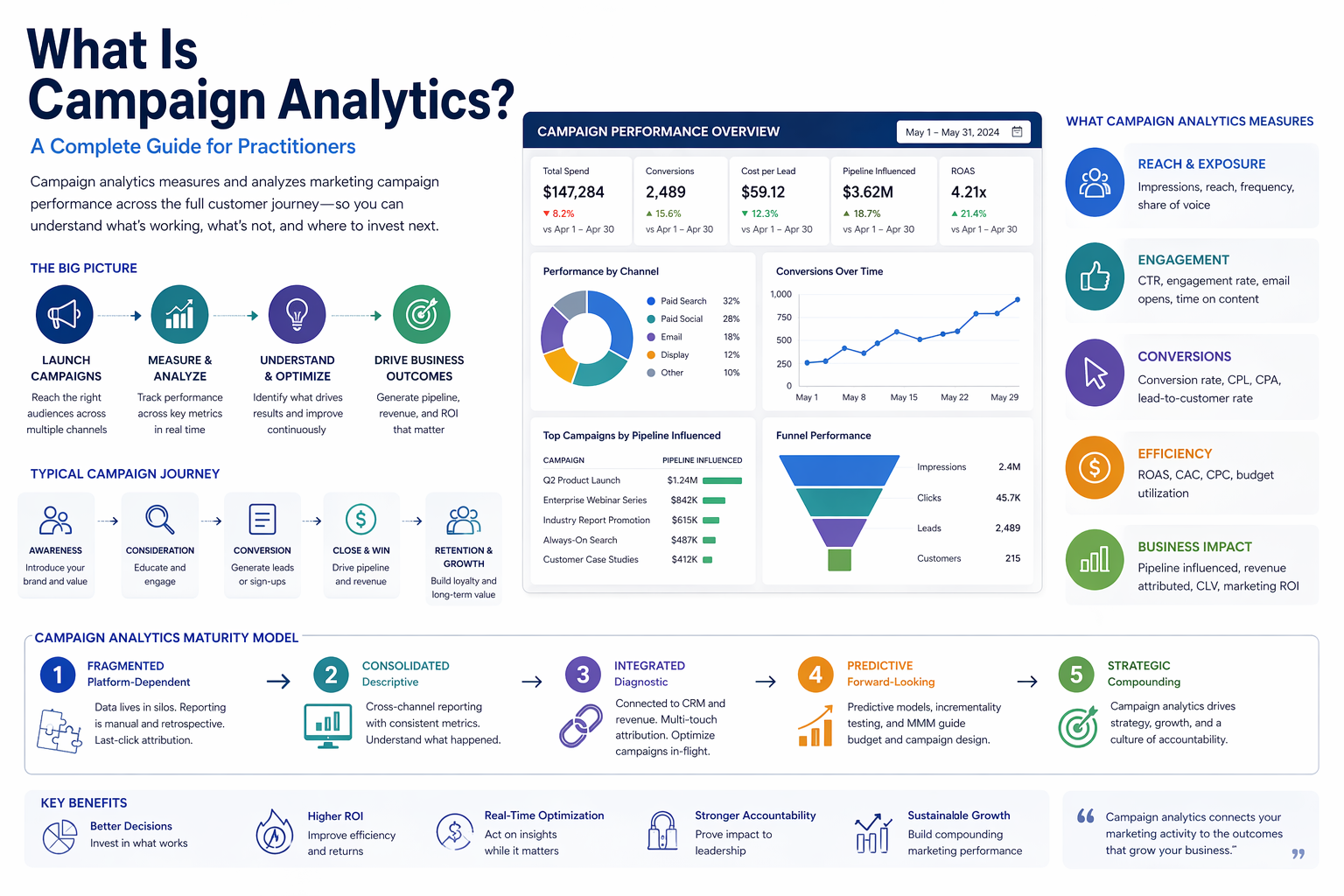
What Is Campaign Analytics? A Complete Guide for Practitioners
Campaign analytics is the structured practice of collecting, measuring, and analyzing data from marketing campaigns to understand what is working, what is not, and where to invest next. It moves marketing teams beyond single-channel reporting into a unified view of how campaigns perform across the full customer journey — connecting creative decisions, audience targeting, spend allocation, and business outcomes into one coherent measurement picture.
Where web analytics focuses on user behavior on digital properties, campaign analytics focuses on the marketing activity itself: did the campaigns you launched reach the right audiences, generate the outcomes you intended, and deliver a return worth the investment?
According to Improvado’s campaign analytics framework, campaign analytics “provides a unified view of how campaigns perform across channels such as paid media, social, email, search, and even offline touchpoints — helping organizations understand not just whether a campaign worked, but why it worked — or didn’t.”
That distinction matters. Most marketing teams can report on whether a campaign ran. Fewer can explain why it succeeded or failed, and fewer still can use that understanding to make better decisions about the next one.
What Campaign Analytics Measures
Campaign analytics captures performance data across several interconnected dimensions. The specific metrics that matter depend on campaign objectives, but the core measurement framework spans five categories.
Reach and Exposure Metrics
These measure how widely a campaign distributed its message:
- Impressions — the total number of times a campaign asset was displayed to an audience
- Reach — the number of unique individuals who were exposed to the campaign
- Frequency — the average number of times each individual was exposed
- Share of voice — a campaign’s presence in the market relative to competitors
Engagement Metrics
These measure how audiences responded to campaign content:
- Click-through rate (CTR) — the percentage of people who clicked on a campaign element relative to total impressions
- Engagement rate — interactions (likes, shares, comments, saves) relative to audience size or impressions
- Email open rate — the percentage of successfully delivered emails that recipients opened
- Time on content — how long audiences engaged with campaign assets such as landing pages or video content
Conversion Metrics
These measure whether audiences took the actions the campaign was designed to drive:
- Conversion rate — the percentage of campaign-driven visitors who completed a target action
- Cost per lead (CPL) — total campaign spend divided by the number of leads generated
- Cost per acquisition (CPA) — the cost required to acquire one new customer or convert one lead
- Lead-to-customer rate — the percentage of campaign-generated leads that eventually became paying customers
Efficiency Metrics
These measure how effectively campaign spend was deployed:
- Return on ad spend (ROAS) — revenue generated for every dollar invested in advertising
- Customer acquisition cost (CAC) — the total cost of acquiring one new customer across all marketing and sales activity
- Budget utilization — the percentage of allocated campaign budget that was actually spent, a signal of pacing discipline
- Cost per click (CPC) — the average cost of each click generated by a paid campaign
Business Impact Metrics
These connect campaign performance to organizational outcomes:
- Pipeline influenced — the total pipeline value touched by campaign activity across the buyer journey
- Revenue attributed — the revenue credited to specific campaigns through an attribution model
- Customer lifetime value (CLV) — the total revenue a campaign-acquired customer is expected to generate over their relationship with the business
- Marketing ROI — the net return on total marketing investment after accounting for all costs
As Amplitude notes, tracking CLV by campaign source is one of the most powerful but underused campaign analytics practices — because it reveals which channels acquire the most valuable long-term customers, not just the highest volume of short-term conversions.
Who Uses Campaign Analytics?
Campaign analytics serves a wide range of roles within marketing and commercial organizations. Each stakeholder uses it differently, but all depend on it to make better decisions about where to spend, what to say, and who to target.
Campaign analytics is particularly valuable for:
- Paid media managers who use campaign data to optimize bids, creative, and audience targeting in real time across paid search and social platforms
- Email marketers who track open rates, click-through rates, and conversion sequences to refine nurture strategies
- Content marketers who measure which topics, formats, and distribution channels generate the most qualified engagement
- Demand generation teams who analyze pipeline contribution across campaign programs to justify budget and headcount
- Marketing analytics managers who aggregate campaign data across channels into unified performance views for leadership
- CMOs and VPs of Marketing who use campaign measurement to demonstrate marketing’s contribution to revenue and defend budget decisions with the CFO
- Growth and retention marketers who use cohort analysis and campaign segmentation to optimize acquisition efficiency and lifetime value
The Oracle marketing analytics resource captures the organizational significance: modern campaign analytics has created “a culture of accountability in marketing that brings a laser-like focus on justifying marketing spend and headcount.” That accountability is not optional in B2B marketing today — it is table stakes for any analytics leader who wants a seat at the strategic table.
Why Campaign Analytics Matters
The business case for campaign analytics is straightforward: without it, marketing spend decisions are based on intuition rather than evidence. With it, organizations can identify which activities generate returns, which are wasting budget, and where the next dollar of investment will have the greatest impact.
Research from Saras Analytics found that companies using advanced campaign analytics frameworks achieve 20–30% higher ROI compared to peers who rely only on platform-level reporting. The gap between surface-level reporting and structured campaign analysis is not marginal — it is measurable and significant.
The consequences of poor campaign analytics are equally concrete:
- Budget misallocation — investment flows toward channels that look productive on vanity metrics but do not contribute to pipeline or revenue
- Attribution blind spots — without multi-touch measurement, the channels that assist conversions are systematically underfunded because they do not capture last-click credit
- Audience waste — campaigns reach broad audiences when behavioral and firmographic data could concentrate spend on the highest-probability segments
- Slow optimization cycles — without real-time or near-real-time performance monitoring, underperforming campaigns run for weeks before anyone intervenes
As Hightouch estimates, US companies lose an average of $611 billion annually due to poor data quality and the subsequent misalignment between campaign targeting and actual customer behavior. Campaign analytics is the operational discipline that closes that gap.
Types of Campaign Analytics
Campaign analytics applies differently depending on the channel being measured. Each channel produces distinct data signals that require specific measurement approaches.
Paid Search Analytics
Paid search analytics tracks performance across Google Ads and Microsoft Ads campaigns. It measures keyword-level efficiency, quality score, ad group performance, and conversion rates by search intent.
Paid search rewards analytical precision — small shifts in bid strategy, match type, or landing page relevance produce measurable changes in CPA within days, making this the most immediately responsive channel to analytics-driven decisions.
Key metrics: CTR, CPC, quality score, conversion rate, CPA, impression share
Paid Social Analytics
Paid social analytics covers advertising on LinkedIn, Meta, and other social platforms. For B2B marketers specifically, LinkedIn campaign analytics deserves particular attention — LinkedIn’s targeting capabilities around job title, seniority, company size, and industry make firmographic segmentation central to performance measurement.
Key metrics: CPL, engagement rate, video completion rate, audience match rate, pipeline influenced
Email Campaign Analytics
Email analytics goes beyond open rates and click rates. Advanced email campaign analysis tracks what recipients do after clicking — whether they convert on a landing page, how they engage with the product or site, and whether email-acquired leads convert at a higher or lower rate than other channels.
Key metrics: Open rate, CTR, CTOR (click-to-open rate), unsubscribe rate, conversion rate, revenue per email
Content Campaign Analytics
Content analytics tracks the performance of blog posts, whitepapers, webinars, and video content. The goal is understanding which content attracts the most qualified audiences and moves them through the buyer journey, not just which pieces generate the most traffic.
Key metrics: Organic traffic, time on page, lead capture rate, content-influenced pipeline, return visitor rate
Multi-Channel and Omnichannel Analytics
The most sophisticated campaign analytics practice integrates data across all channels into a single performance view. This requires solving two interconnected problems: data unification (bringing campaign data from disparate platforms into a single source of truth) and attribution (assigning appropriate credit to each channel’s contribution to a conversion).
Supermetrics describes this as the core challenge of modern campaign analytics: “You don’t want your marketing reporting dashboard jam-packed with every number under the sun. Instead, choose data points that illuminate campaign effectiveness” — and connecting those data points across channels is where most organizations struggle.
Campaign Attribution: The Core Measurement Challenge
Attribution is the most strategically consequential and most commonly mismanaged element of campaign analytics. It determines how credit for conversions and revenue is distributed across the touchpoints in a buyer journey — and therefore shapes every budget allocation decision that follows.
Common Attribution Models
Last-click attribution assigns 100% of credit to the final touchpoint before conversion. It is simple but systematically undervalues awareness and mid-funnel channels that generate the interest and intent that drive the eventual conversion.
First-click attribution assigns 100% of credit to the first touchpoint. It overvalues awareness channels and undervalues the nurture and activation activity that moves leads to decision.
Linear attribution distributes credit equally across all touchpoints in the buyer journey. It avoids the extremes of single-touch models but treats all touchpoints as equally important regardless of their actual influence.
Time-decay attribution assigns more credit to touchpoints closer to the conversion event. It captures recency effects but risks systematically undervaluing top-of-funnel activity.
Data-driven attribution uses machine learning to distribute credit based on actual patterns in conversion data. It is the most accurate model for organizations with sufficient conversion volume, and it is now the default model in Google Analytics 4.
For B2B marketing organizations with long, complex buying cycles and multiple stakeholders per account, no single attribution model tells the complete story. The most analytically mature teams use multi-touch attribution as a directional input while complementing it with incrementality testing and Marketing Mix Modeling for strategic budget decisions.
Campaign Analytics Maturity Model
Most organizations collect campaign data. Few turn that data into decisions systematically. The following five-level maturity model defines what campaign analytics capability looks like at each stage and what progression requires.
Level 1 — Fragmented (Platform-Dependent)
What it looks like: Campaign performance is measured separately within each platform. Google Ads data lives in Google Ads. LinkedIn data lives in LinkedIn. Email data lives in the email tool. There is no unified view of campaign performance across channels. Reporting is manual and retrospective. Attribution defaults to last-click because it requires no setup.
Common symptoms:
- Each channel team reports its own performance using its own metrics and definitions
- There is no single source of truth for campaign performance
- “Total campaign results” are assembled by copying numbers from multiple platform dashboards into a spreadsheet
- Attribution conversations are avoided because the data to support them does not exist
- Decisions about budget allocation are made based on historical spend patterns, not performance evidence
What to focus on:
- Implement consistent UTM parameter tagging across all campaign traffic so channel performance can be compared in a single analytics tool
- Establish a shared campaign taxonomy and naming convention across all channels and teams
- Build a basic cross-channel dashboard that aggregates top-level metrics from the major platforms into one view
- Define a small set of shared KPIs that all channel teams report against consistently
Level 2 — Consolidated (Descriptive)
What it looks like: Campaign data from major channels is consolidated into a shared reporting environment. Teams can compare performance across channels using consistent metric definitions. Reporting is regular and structured. The conversation has shifted from “what happened in each channel” to “how did the campaign perform overall.”
Common symptoms:
- A centralized campaign dashboard exists but is primarily used for reporting, not decision-making
- Attribution is still predominantly last-click or first-click
- Optimization decisions are made after campaigns complete, not during them
- Audience segmentation is demographic rather than behavioral
- There is limited connection between campaign performance and downstream outcomes like pipeline or revenue
What to focus on:
- Move from post-campaign reporting to in-flight monitoring with defined performance thresholds that trigger optimization reviews
- Begin connecting campaign data to CRM data to track lead quality, not just lead volume
- Explore multi-touch attribution models and understand their implications for how budget is currently allocated
- Build basic audience segmentation into campaign design, not just as a reporting cut after the fact
Level 3 — Integrated (Diagnostic)
What it looks like: Campaign analytics is connected to CRM and revenue data, enabling teams to evaluate campaigns not just on leads generated but on pipeline created and revenue influenced. Attribution goes beyond last-click. Optimization is continuous, not retrospective. Audience performance is segmented by firmographic and behavioral characteristics, not just demographics.
Common symptoms:
- Campaign performance reviews regularly include pipeline and revenue data alongside efficiency metrics
- The marketing team can demonstrate which campaigns influenced closed deals, not just which generated the most leads
- A/B testing is part of the standard campaign workflow, not an occasional experiment
- Budget reallocation decisions are made mid-quarter based on performance data, not at annual planning only
- The analytics team can identify which audience segments convert at the highest rate and feed that insight back into targeting
What to focus on:
- Develop incrementality testing capability to validate whether campaign-attributed conversions are truly incremental or would have occurred without the campaign
- Build audience activation workflows that use campaign performance data to refine targeting in real time
- Establish lead quality scoring that connects early campaign engagement signals to downstream revenue outcomes
- Create executive reporting that frames campaign performance in revenue and pipeline terms, not marketing-specific metrics
Level 4 — Predictive (Forward-Looking)
What it looks like: Campaign analytics informs not just how to evaluate past campaigns but how to design future ones. Predictive models identify the audience segments, messages, timing, and channel combinations most likely to generate target outcomes before a campaign launches. Budget allocation is driven by forecasted return, not historical patterns.
Common symptoms:
- Predictive audience models identify high-propensity segments before campaigns launch
- Marketing Mix Modeling provides a portfolio-level view of channel contribution and optimal budget distribution
- Campaign design decisions — creative, audience, timing, channel — are informed by performance data from previous campaigns
- The analytics team contributes to quarterly and annual planning with forecasted campaign outcomes, not just historical benchmarks
- Real-time anomaly detection alerts the team to performance deviations within hours, not days or weeks
What to focus on:
- Build or commission a Marketing Mix Modeling capability that separates the contribution of each channel from external factors like seasonality and competitive activity
- Develop scenario-planning models that project campaign outcomes under different budget allocation assumptions
- Integrate first-party data signals — product usage, CRM behavior, website engagement — into campaign targeting and measurement
- Establish closed-loop reporting that connects campaign activity all the way through to customer retention and lifetime value
Level 5 — Strategic (Compounding)
What it looks like: Campaign analytics is embedded in the strategic decision-making process of the marketing organization. The measurement function does not just evaluate campaigns — it shapes them. Analytics insights drive decisions about market positioning, audience strategy, product messaging, and long-term investment allocation.
Common symptoms:
- Campaign performance data informs product roadmap decisions and content investment priorities
- The analytics team operates as a strategic research function, not just a reporting one
- Marketing investment decisions are defended to the board with the same rigor as capital expenditure decisions
- Measurement infrastructure is architected for durability and privacy compliance, not just current convenience
- The organization benchmarks campaign performance against industry peers systematically, not anecdotally
How to Progress as a Campaign Analyst
Progression in campaign analytics follows a consistent pattern across organizations and individuals: it begins with technical data access, moves through analytical interpretation, and matures into strategic influence. The bottleneck at each stage is different.
From Level 1 to Level 2: Solve the Data Unification Problem
The most important move at this stage is creating a single source of truth for campaign data. This means:
- Implementing rigorous UTM tagging discipline across every campaign and every channel
- Choosing a reporting environment — whether GA4, a BI tool like Looker or Tableau, or a dedicated marketing analytics platform — and committing to it as the shared measurement standard
- Establishing campaign naming conventions that allow performance to be sliced by campaign type, audience, objective, and channel consistently
- Documenting metric definitions so that every stakeholder interprets the same numbers the same way
From Level 2 to Level 3: Connect Campaigns to Revenue
The defining move at this stage is connecting campaign activity to downstream commercial outcomes. This requires:
- Integrating campaign data with CRM data — typically through a CRM platform like Salesforce or HubSpot — to track lead quality and pipeline contribution
- Moving from last-click attribution to a multi-touch model, even an imperfect one, to get a more accurate picture of channel contribution
- Developing a lead quality framework that distinguishes between campaigns that generate volume and those that generate value
- Learning to present campaign results in revenue and pipeline terms to executive stakeholders
From Level 3 to Level 4: Build Predictive and Experimental Capability
At this stage, the data foundation is solid. The gap is in analytical sophistication:
- Developing incrementality testing methodology — understanding the difference between correlation and causation in campaign performance
- Building or partnering on Marketing Mix Modeling to understand the aggregate contribution of each channel at a portfolio level
- Developing forecasting models that allow campaign outcomes to be projected, not just reported
- Creating closed-loop measurement systems that connect early campaign signals to long-term customer outcomes
From Level 4 to Level 5: Operate as a Strategic Asset
The final progression is organizational, not technical:
- Translating campaign intelligence into strategic recommendations about where the organization should invest, which markets to prioritize, and how to position against competitors
- Building analytical capability across the marketing team, not just within a specialist analytics function
- Designing measurement infrastructure that is durable — privacy-compliant, first-party data-driven, and resilient to platform changes
Campaign Analytics in the Broader Measurement Stack
Campaign analytics sits at the middle layer of the marketing measurement stack, between the behavioral foundation provided by web analytics and the strategic synthesis provided by marketing analytics.
Web analytics (covered in Article 1 of this series) provides the behavioral signal layer — what users do on digital properties once a campaign delivers them there. Without accurate web analytics, campaign conversion data is unreliable.
Campaign analytics connects marketing activity to those behavioral signals and to downstream commercial outcomes. It answers whether specific marketing investments generated specific results.
Marketing analytics integrates campaign performance data with financial, market, and competitive data to answer strategic questions about overall marketing effectiveness, optimal budget allocation, and long-term growth strategy.
Each layer depends on the integrity of the layer below it. Organizations that invest in campaign analytics without a solid web analytics foundation will consistently measure campaign outcomes against incomplete or inaccurate behavioral data. Organizations that skip campaign analytics and jump directly to marketing analytics will lack the granular activity-level data needed to make meaningful optimization decisions.
Key Takeaways
Campaign analytics is the discipline of connecting marketing activity to measurable business outcomes. It is not a dashboard or a reporting cadence — it is a practice that requires data unification, attribution methodology, analytical judgment, and stakeholder communication working together.
Most marketing organizations operate at Level 1 or Level 2 of campaign analytics maturity — measuring channel performance in isolation and reporting on what happened after campaigns close. The progression to Level 3 and beyond, where campaign data drives real-time optimization and influences strategic budget decisions, requires crossing two significant thresholds: connecting campaigns to revenue data, and moving from last-click to multi-touch attribution.
For practitioners, the most valuable capability to develop is not platform proficiency — it is the ability to frame campaign performance in the language of business outcomes. The team that can show which campaigns influenced pipeline, at what cost, and with what predictive implication for future investment, is the team that earns a seat at the strategic table.
References and Further Reading
Foundational Definitions
- Improvado — What Is Campaign Analytics? — Comprehensive practitioner-level definition covering metrics, tools, and strategic context
- Latent View — Campaign Analytics Key Metrics and Tools — Enterprise-focused overview of campaign analytics frameworks and channel-specific measurement
Attribution and Measurement Methodology
- Google Analytics 4 — Data-Driven Attribution — Official documentation on GA4’s default attribution model and how it distributes credit across touchpoints
- Supermetrics — How to Analyze Marketing Campaigns — Practical guide to campaign analysis by channel type and campaign objective
Tools and Platforms
- Google Ads — The leading paid search platform with native campaign analytics
- HubSpot Marketing Analytics — CRM-native campaign measurement platform integrating marketing and sales data
- Amplitude — Marketing Campaign Analytics — Product analytics platform with advanced campaign and retention measurement
Industry Research and Context
- Saras Analytics — Marketing Campaign Analytics Guide — Research-backed overview including the 20–30% ROI uplift from advanced campaign analytics frameworks
- Oracle — Marketing Measurement and Accountability — Enterprise perspective on campaign measurement culture and organizational accountability
- Hightouch — What Is Campaign Analytics? — Data warehouse-native approach to campaign measurement including composable CDP methodology
This article is part of the Analytics Disciplines Series:
- Article 1: What Is Web Analytics? A Complete Guide for Practitioners
- Article 2: What Is Campaign Analytics? A Complete Guide for Practitioners — You are here
- Article 3: What Is Marketing Analytics? A Complete Guide for Practitioners — Coming next