


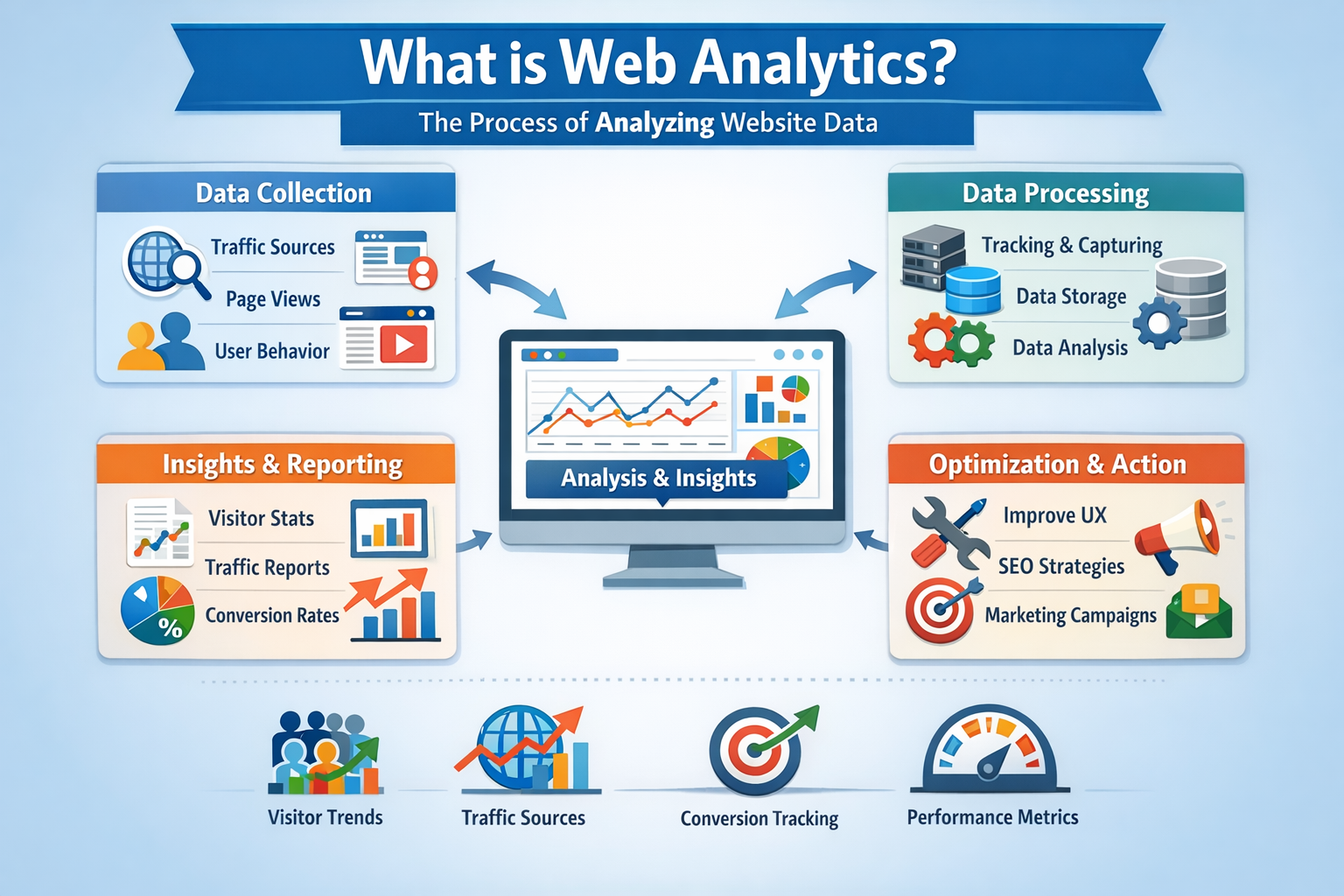
What Is Web Analytics? A Complete Guide for Practitioners
Web analytics is the measurement, collection, analysis, and reporting of web data to understand and optimize web usage. According to Wikipedia’s definition of web analytics, it is “not just a process for measuring web traffic but can be used as a tool for business and market research and to assess and improve website effectiveness.”
At its core, web analytics answers one fundamental question: what are people doing on your digital properties, and why does it matter?
Web analytics tools — most commonly Google Analytics 4 (GA4), Adobe Analytics, or Matomo — capture how users arrive at a site, how they navigate through its pages, what actions they complete, and where they leave. This behavioral data forms the foundational measurement layer for any digital marketing operation, providing the raw intelligence that campaign analytics and marketing analytics depend on to function.
Without accurate, well-structured web analytics, every upstream measurement discipline is built on a compromised foundation.
What Web Analytics Measures
Web analytics captures user behavior across several interconnected dimensions. Google Analytics, the most widely used web analytics platform in the world, organizes this data into the following core areas:
- Traffic acquisition — where visitors come from, including organic search, paid advertising, email, social media, direct visits, and referral sources
- User behavior — how visitors navigate pages, which content they engage with, how long they remain on the site, and where they exit
- Conversion events — specific actions that signal intent or value, such as form completions, content downloads, demo requests, or purchases. In GA4, these are now formally referred to as Key Events following Google’s 2024 nomenclature update
- Audience characteristics — geographic location, device type, browser, language, and whether users are new or returning
- Site performance — page load speed, technical errors, and crawl issues that affect user experience and search visibility
- Funnel analysis — the sequence of steps users take toward a conversion goal and where drop-off occurs in that sequence
- Engagement quality — time on page, scroll depth, interaction rate, and session depth as indicators of content relevance
Together, these dimensions create a behavioral map of how audiences interact with digital properties — a map that informs decisions across content, design, paid media, and product development.
On-Site vs. Off-Site Web Analytics
Web analytics divides into two fundamental categories, a distinction well established in academic and practitioner literature:
On-site web analytics measures a visitor’s behavior once they arrive on your website. This includes which pages they visit, how they navigate, and whether they complete conversion goals. Most organizations when they say “web analytics” are referring to on-site measurement.
Off-site web analytics measures a website’s presence and performance in the broader digital ecosystem, independent of whether visitors land on the site. This includes search engine visibility, social media mentions, share of voice, and audience potential. SEO tools, social listening platforms, and competitive intelligence tools typically power this layer.
Most organizations underinvest in off-site analytics and focus almost entirely on on-site measurement. Both are necessary for a complete picture of digital performance.
Who Uses Web Analytics?
Web analytics is a cross-functional discipline that serves multiple teams within an organization. Its data is relevant wherever digital performance influences business decisions.
Web analytics is particularly valuable for:
- Digital and web analysts who monitor day-to-day site performance and surface behavioral insights
- SEO specialists who use organic traffic and engagement data to evaluate content strategy and search visibility
- UX and product designers who analyze behavior flows, heatmaps, and session recordings to improve site architecture
- Content marketers who assess which topics, formats, and distribution channels drive the deepest audience engagement
- Paid media managers who connect ad traffic to on-site behavior and conversion outcomes
- Marketing analytics leaders who integrate web data into attribution models and broader marketing measurement frameworks
- E-commerce and conversion rate optimization teams who use funnel data to reduce drop-off and increase transaction rates
The relevance of web analytics extends beyond the analytics function. Executives, product managers, and commercial leaders increasingly rely on web behavioral data to make decisions about site investment, content priorities, and market positioning.
Why Web Analytics Matters
Web analytics is the earliest signal layer in a digital marketing operation. It tells organizations what is happening in real time, before that data has been attributed to a campaign, connected to a business outcome, or integrated with CRM or revenue data.
According to research cited by UXCam, companies that use web analytics effectively are 2.8 times more likely to achieve their marketing goals than those that do not. The business case for structured web measurement is well established across industry research.
Organizations that underinvest in web analytics foundations routinely experience several costly problems:
- Misattributed revenue — when tracking gaps prevent accurate identification of which channels drove conversions. Research from Search Engine Land suggests that up to 60% of “direct” traffic is actually misattributed campaign traffic due to missing UTM parameters
- Inflated traffic data — when bot traffic, spam referrals, or misconfigured filters distort reported session volumes
- Missing conversion signals — when key events are not tracked, leaving campaign and marketing analytics teams unable to measure outcomes
- Broken measurement after site changes — when development deployments overwrite tracking configurations without QA validation
- Incomplete audience understanding — when behavioral segmentation is absent, making personalization and targeting decisions speculative
Conversely, organizations with mature web analytics capabilities can identify which content earns audience attention, which user journeys convert most efficiently, where site friction costs conversions, and which traffic sources deliver the highest-quality visitors.
Key Components of a Web Analytics Practice
A functioning web analytics practice encompasses more than a tool installation. It requires five interconnected components working in coordination.
1. Data Collection Infrastructure
The technical foundation of web analytics — the tags, tracking pixels, and event configurations that capture user behavior. This typically involves a tag management system such as Google Tag Manager, Tealium, or Adobe Launch that deploys and manages tracking scripts without requiring direct code changes from developers.
A well-structured data layer ensures that behavioral data is captured consistently, accurately, and in a format that supports downstream analysis.
2. Measurement Planning
Before tracking is implemented, a clear measurement plan defines what should be tracked and why. This document maps business objectives to specific digital behaviors, identifies the conversion events that signal value, and establishes the naming conventions and taxonomy that keep data organized and interpretable over time.
Google’s official GA4 setup guidance emphasizes measurement planning as a prerequisite for meaningful implementation — not an afterthought.
Organizations without a measurement plan typically accumulate years of inconsistent, unreliable data that cannot support strategic decisions.
3. Reporting and Dashboards
Structured reporting translates raw behavioral data into organized views that different stakeholders can use. This includes executive dashboards for high-level performance monitoring, channel-specific reports for media teams, and detailed funnel analyses for conversion optimization work.
Tools like Google Looker Studio and Tableau are commonly used alongside GA4 to build custom reporting layers that go beyond native platform reports.
The discipline of web analytics reporting lies not in building more reports, but in designing fewer, more decision-relevant views that surface the right information to the right audience at the right cadence.
4. Analysis and Insight Generation
Data collection and reporting are mechanical. Analysis is intellectual. Web analytics analysis involves interpreting behavioral patterns, forming hypotheses about why those patterns exist, and recommending actions that address underlying causes.
This is where web analytics creates business value — not in the dashboard itself, but in the thinking that the data enables.
5. Testing and Optimization
Mature web analytics practices close the loop between insight and action through structured testing. A/B tests, multivariate experiments, and user research validate hypotheses before full implementation, reducing the risk of changes that damage performance rather than improve it.
Platforms like Google Optimize’s successor ecosystem and tools such as Optimizely and VWO support this experimentation layer.
Web Analytics Maturity Model
Organizations and individual practitioners exist at different levels of web analytics capability. Understanding where you currently stand is the prerequisite for making meaningful progress.
As Gartner’s research on marketing analytics maturity establishes, reaching advanced measurement capability requires a structured assessment of current state before organizations can map a credible path forward. Similarly, Alteryx’s analytics maturity framework identifies people, processes, technology, and data governance as the four dimensions through which maturity must be assessed.
The following five-level model applies those principles specifically to web analytics.
Level 1 — Foundational (Reactive)
What it looks like: A web analytics tool is installed and collecting data, but implementation is incomplete or inconsistent. Reporting is manual and ad hoc. The team checks analytics occasionally to answer specific questions rather than monitoring performance systematically. Conversion events may be missing or misconfigured. Data is rarely questioned for accuracy.
Common symptoms:
- Reporting focuses on pageviews, sessions, and bounce rate without connecting those metrics to business outcomes
- No formal measurement plan exists; tracking decisions are made reactively
- Multiple people define the same metrics differently, producing conflicting numbers
- Analytics data is rarely referenced in marketing planning or budget decisions
- No process exists for validating tracking accuracy after site changes
What practitioners at this level should focus on:
- Auditing existing tracking implementation for gaps and errors using tools like Google Tag Assistant and GA4 DebugView
- Documenting a basic measurement plan that maps key business objectives to digital events
- Establishing consistent metric definitions across the team
- Configuring core conversion events — or Key Events in GA4 terminology — in the analytics platform
- Setting up a basic performance dashboard that stakeholders can reference weekly
Level 2 — Developing (Descriptive)
What it looks like: Tracking is largely accurate and complete. Regular reporting cadences exist. The team can describe what happened — traffic trends, channel performance, conversion rates — with reasonable confidence. Data quality is monitored periodically. Analytics is consulted as part of routine marketing operations.
Common symptoms:
- Dashboards report on what happened but rarely explain why it happened
- Channel attribution relies primarily on last-click or default attribution models
- Segmentation is basic — geographic or device-based rather than behavioral
- Insights are reported rather than recommended; analytics output is informational, not prescriptive
- A/B testing exists in theory but is inconsistently applied
What practitioners at this level should focus on:
- Moving from descriptive reporting to diagnostic analysis — not just what the data shows, but what is causing the pattern and what should be done about it
- Implementing behavioral segmentation to understand how different audience groups interact with the site differently
- Establishing a structured QA process to validate tracking accuracy on an ongoing basis
- Learning to communicate analytics findings in business terms rather than metric terms
Level 3 — Defined (Diagnostic)
What it looks like: The web analytics practice operates with documented standards, consistent processes, and proactive monitoring. The team routinely identifies causes behind performance changes and makes recommendations that marketing and product teams act on. Segmentation is behavioral and contextual. Attribution goes beyond last-click. Data quality is actively governed.
Common symptoms:
- Analytics insights regularly influence content decisions, UX changes, and channel investment
- Funnel analysis identifies specific drop-off points and drives CRO initiatives
- Behavioral cohort analysis reveals how different user segments engage differently with the site
- Anomaly detection is in place — a feature GA4 introduced to alert teams to tracking issues or performance changes in near real time, as covered in Google Analytics 2024 updates coverage
- The analytics team can distinguish between statistical noise and meaningful performance shifts
What practitioners at this level should focus on:
- Developing audience segmentation frameworks that connect behavioral data to marketing personas
- Integrating web analytics data with CRM and campaign data to begin connecting site behavior to downstream business outcomes
- Building experimentation into the standard operating model — every significant site change should be hypothesis-driven and validated
- Learning statistical methods for distinguishing significant performance changes from random variation
Level 4 — Advanced (Predictive)
What it looks like: Web analytics is fully integrated with campaign and marketing analytics. The team builds predictive models — propensity scoring, content recommendation logic, churn risk indicators — on top of behavioral data. Experimentation is systematic and tied to clear business hypotheses. Analytics findings drive executive-level decisions about site investment, content strategy, and audience targeting.
Common symptoms:
- Behavioral data from the site feeds directly into CRM or Customer Data Platform (CDP) systems, enriching audience profiles
- GA4’s native BigQuery integration — one of the platform’s most significant features — is actively used for custom modeling and raw event-level analysis
- Attribution modeling is sophisticated — multi-touch, data-driven, or incrementality-based rather than rule-based
- The analytics team contributes directly to revenue forecasting and marketing planning cycles
- Web analytics KPIs are directly connected to commercial performance indicators
What practitioners at this level should focus on:
- Developing data science competencies to build and validate predictive behavioral models
- Integrating Consent Mode V2 and privacy-preserving measurement approaches as third-party cookie deprecation limits traditional tracking
- Designing audience activation frameworks that turn web behavioral signals into marketing and sales actions
- Contributing to marketing mix modeling by providing clean, well-structured web performance data
Level 5 — Optimized (Strategic)
What it looks like: Web analytics is embedded in the strategic decision-making process of the marketing organization. Measurement drives product development, content investment, audience strategy, and budget allocation. The analytics function operates as a competitive intelligence capability.
As McKinsey research on data-driven organizations demonstrates, companies that achieve advanced analytics maturity are 23 times more likely to acquire new customers and 6 times more likely to retain existing ones compared to organizations that rely on intuition-based decision-making.
Common symptoms:
- Web behavioral data is a first-class input into board-level and C-suite marketing reviews
- The analytics infrastructure is architected for long-term durability — server-side tracking, first-party data collection, and privacy-compliant measurement that will not degrade as the regulatory environment changes
- Cross-functional teams routinely conduct data-informed experiments that influence product roadmaps
- The analytics function publishes internal research that shapes organizational strategy
- External benchmarking is systematic, not anecdotal
How to Progress as a Web Analyst
Maturity progression in web analytics is not primarily a question of learning more tools. It is a question of developing judgment — the ability to move from data to insight to recommendation to impact.
As Gartner’s marketing maturity model confirms, the most significant progression gaps organizations face are not technical — they are analytical, organizational, and communicative. The following framework applies at both the individual and team level.
From Level 1 to Level 2: Build the Foundation Correctly
The most important move at this stage is shifting from tool operation to measurement discipline:
- Conduct a full tracking audit to identify gaps, duplicate tags, and misconfigurations. Use Google Tag Assistant as a starting diagnostic tool
- Write a measurement plan before implementing any new tracking
- Define a small number of meaningful KPIs rather than reporting on every available metric
- Establish data governance basics: consistent naming conventions, event taxonomy, and documentation
The mindset shift required here is from reactive reporting to proactive measurement ownership.
From Level 2 to Level 3: Develop Analytical Thinking
At this transition, the technical skills are sufficient. The gap is in interpretation and communication:
- Practice root-cause analysis — when a metric changes, systematically diagnose why before reporting the number
- Learn segmentation — breaking aggregate data into meaningful subgroups that reveal behavior differences invisible at the surface level
- Build stakeholder communication skills — presenting findings in terms of business decisions, not metric movements
- Develop a basic statistical literacy — understanding sample size, confidence intervals, and the difference between correlation and causation
From Level 3 to Level 4: Cross the Integration Boundary
The defining characteristic of Level 4 is integration — connecting web analytics with the rest of the marketing and commercial data ecosystem:
- Develop SQL proficiency to query event-level data from GA4 via BigQuery
- Build campaign analytics literacy — understanding how web behavioral data connects to paid media performance, email engagement, and CRM outcomes
- Develop working knowledge of attribution modeling: multi-touch attribution, media mix modeling, and incrementality testing
- Understand privacy and compliance: how GA4 Consent Mode, server-side tracking, and consent management platforms work in a post-cookie measurement environment
From Level 4 to Level 5: Operate as a Strategic Asset
Reaching Level 5 is less about individual skill and more about organizational influence:
- Design measurement strategy rather than execute measurement tactics
- Build and develop analytical capability across the organization through training, documentation, and standards
- Translate behavioral intelligence into strategic business decisions
- Architect measurement systems for long-term durability, not short-term convenience
- Position the analytics function as a competitive advantage rather than a reporting service
Web Analytics in the Broader Measurement Landscape
Web analytics does not operate in isolation. As established in the Wikipedia entry on Analytics, web analytics feeds directly into marketing analytics — the discipline of using data to maximize marketing effectiveness and demonstrate business impact.
The full measurement stack looks like this:
Web analytics captures what users do on digital properties. It provides the behavioral signal data that feeds into campaign evaluation and strategic decision-making.
Campaign analytics uses web behavioral data — alongside ad platform data and CRM records — to evaluate whether specific marketing activities achieved their objectives and at what cost.
Marketing analytics integrates web, campaign, and commercial data to answer strategic questions about marketing’s contribution to business growth, how budget should be allocated across channels, and how marketing performance compares to competitive benchmarks.
Each layer depends on the integrity of the layer below it. Organizations that attempt to build sophisticated marketing analytics or campaign measurement on top of poorly implemented web tracking will consistently produce unreliable conclusions. Investment in web analytics foundations is not a technical prerequisite — it is a strategic one.
Key Takeaways
Web analytics is the discipline of measuring and interpreting digital user behavior to improve performance and support business decisions. It is not a tool or a dashboard. It is a practice — one that requires technical implementation, measurement planning, analytical judgment, and stakeholder communication working together.
Maturity in web analytics progresses from reactive, fragmented data collection toward a fully integrated, predictive measurement capability that influences strategic decisions. According to Gartner’s projections, 65% of B2B sales organizations will transition from intuition-based to data-driven decision-making by 2026 — making investment in analytics maturity not just a best practice, but a competitive necessity.
Most organizations operate at Level 1 or Level 2. The gap between those levels and Level 3 is not primarily technical — it is analytical, organizational, and communicative. For practitioners, the most important investment is not in learning another platform. It is in developing the judgment to turn behavioral data into business recommendations — and the communication skills to make those recommendations land.
Further Reading and Resources
The following resources provide additional depth on the topics covered in this article.
Foundational Definitions
- Web Analytics — Wikipedia — The foundational academic and practitioner definition of the discipline
- Google Analytics — Wikipedia — History, evolution, and overview of the world’s most widely used web analytics platform
- Analytics — Wikipedia — Broader context for how web analytics sits within the analytics discipline
Official Platform Documentation
- Google Analytics 4 Help Center — Official GA4 documentation covering setup, events, attribution, and reporting
- Google Tag Manager — Official documentation for the tag management system used by most GA4 implementations
- GA4 BigQuery Export — Official guide to exporting raw event-level GA4 data to BigQuery for advanced analysis
- GA4 Consent Mode — Official guidance on privacy-compliant measurement in GA4
Maturity Models and Frameworks
- Gartner — Maturity Model for Marketing Analytics — Gartner’s framework for assessing and advancing marketing analytics maturity
- Gartner — Marketing Maturity Model — Gartner’s broader model for building digital marketing capability
- Alteryx — What Is an Analytics Maturity Model? — Comprehensive overview of maturity model frameworks including Gartner, Forrester, and McKinsey
- Airbyte — Analytics Maturity Model — Practical comparison of major analytics maturity frameworks for data teams
Implementation and Best Practices
- GA4 Complete Setup Guide — Digital Applied — Comprehensive GA4 implementation guide covering events, key events, and eCommerce tracking
- Google Analytics Best Practices — SR Analytics — Practitioner-focused guide including UTM tagging, attribution, and common implementation errors
- Top 10 GA4 Best Practices 2025 — Codefixer — Current best practices for GA4 configuration, data retention, and audience building
Industry Research
- McKinsey Analytics Insights — Research on data-driven decision-making and its impact on business performance
- Forrester — Marketing Performance Measurement — Overview of the Forrester marketing measurement maturity framework
- B2B Marketing Measurement — Anteriad and Ascend2 Research — Current research on data confidence and revenue performance in B2B marketing
This article is part of the Analytics Disciplines Series. Continue reading:
- Article 2: What Is Campaign Analytics? A Complete Guide for Practitioners
- Article 3: What Is Marketing Analytics? A Complete Guide for Practitioners